Showing posts with label Kozak. Show all posts

Wednesday, July 27, 2011

RUSSIA, THE LAST EUROPEAN EMPIRE?

European Empires

  An Empire or a Commonwealth?

Империя или Содружество народов?

Un impero o una comunità di popoli?

 Un empire ou une communauté de Peuples?

Ein Kaiserreich oder eine Voelkergemeinschaft?

To the extent that Bolsheviks had resumed war against occupying foreign forces (Russia, German Army, Freikorps, Baltic, Polish, Ukrainian Asiatic, Czech nationalists, Anglo-Americans, Japanese), they gave the impression they were fighting for the salvation of the Russian Empire (irrespective from the monarchic or republican form of the same).
The same happened with World War II and even with the Cold War, where the strength of the Soviet empire seemed, under certain points of view, to vindicate the loss of the Russian Empire. And also, after so many years, it appears that the idea of a “Russian Empire”, something larger than Russian nationality, is still on the agenda (for instance, in the Russian Media). In fact, already present days Russian Federation (“Rossijskaja Federacija”) is larger that simply the Russian “Nation” (“Ruskaja Nacija”). The Russian People (“Ruskij Narod”) is larger than Russia Federation, and the so-called Sovietic citizens (“Sovietskie grazhdane”) are a further concept than the “Russian People”. Moreover, independently from any contrary political will, Russia still exerts a, direct or indirect, influence on the whole of a larger “post-Sovietic space”. So, we can say that, whilst Spanish, Portuguese, Dutch, English, French, German and Italian empires have disappeared, the Russian still exists, even if in a different form.This situation is not very different from the British “Commonwealth” and the French “Francophonie”.
At the beginning, the connection between the new Bolshevik Russia and the Russian Empire was not clear at all. In fact, the “Trip in the Armored Train” of Lenin, as well as the Treaty of Brest-Litowsk, which are the founding events of the success of the Bolshevik movement, were based on a paradoxical deal with the German Empire, whereby Russia would have accepted the creation of new Republics (Finland, Poland more the Balts, Belarus’, Ukraine and Transcaucasia), in the areas occupied by the German Armies, where local nationalists had declared their independence under German sponsorship.
Secondly, it seemed ominous that, after about half a century of rhetoric of self-determination by nationalities, from the side of the socialist movement worldwide, precisely in the “Fatherland of Socialism” the nationalities would have been repressed. Thirdly, it was necessary to recover at least a part of those nationalist leaders which had exerted the power during German occupation, some of them being Marxist. Fourth, most of the Republics did not constitute a “nation” in the Western sense of the word, because they were inhabited by dispersed ethnic entities, including, inter alia, Russians, Germans and Jews.
So, in any case, it was necessary, for managing local administrations, to create a sufficiently consistent local interfaces in the Republics. According to Marxist rhetoric, to create local national bourgeoisies, which were conceived to be similar, from one side, to the Westerns national bourgeoisies, and, from another side, to what the fledging ruling classes of the Republics purported to be.
Stalin, also being himself a Transcaucasian Revolutionary (half Georgian, half Ossetian), was chosen to solve the “nationalities problem”. In reality, the implementation of the Treaty of Brest-Litowsk was not simple, and, for a certain period - corresponding, roughly speaking, to the Russian Civil War -, the Republics remained substantially independent, even if occupied, from time to time, by different, Russian and foreign, armies.
In all that period, the relationships of Russia with other Eastern European Countries (especially Baltic countries, Poland, Ukraine, Rumania, Georgia and Armenia) where heavily influenced by the different situations created in the new bundle of Republics, as well by their evolutions following to independence, civil war, Russian-Polish War, “Dekulakization”, Ukrainization, Russification, 2nd World War, changes of administrative borders, end of the Soviet Union.



Tuesday, July 26, 2011

EAST EUROPEAN NATIONALITIES AND EUROPE

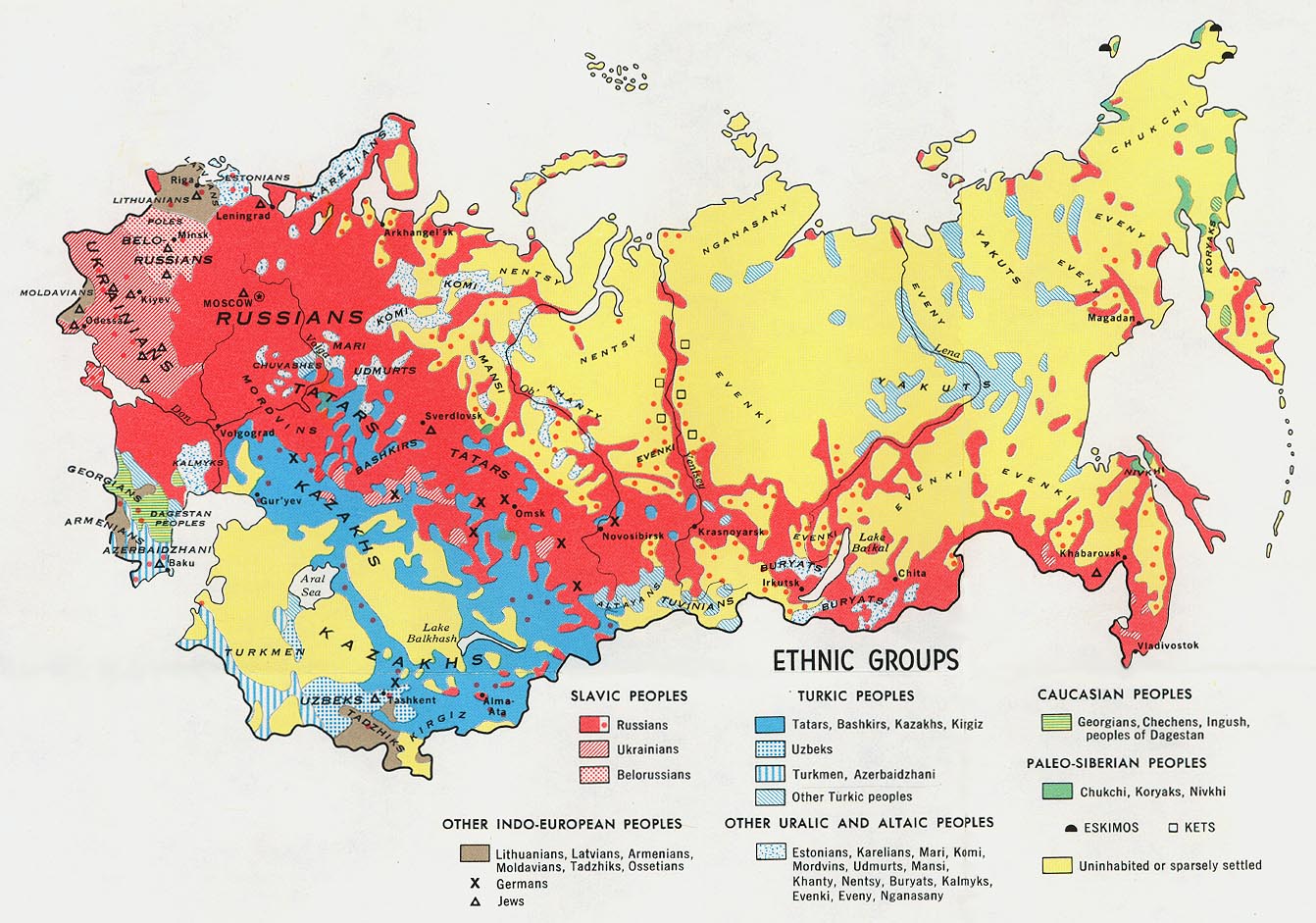
Nationalities in Russia: an Excellent Example of a European  Problem.

Народность в России: необыкной Премьерn всеевропейского вопрос


Les nationalités en Russie: un exemple excellent d'un problème européen. 

Nationalitaeten in Russland ein ausgezeichnetes Beispiel einer europaeischen Probleme.

1.     Nationalities in the Empire

Hostile propaganda, starting from XIX Century, described Russia (not differently, from this point of view from Austria and Turkey) as a “Prison for the Peoples”. This negative stereotype was never been abandoned, either during the Sovietic Period, nor even today, albeit both the Bolsheviks and Elcin’s Russia had made, in fact, remarkable efforts for solving the “National Question”, in a way which cannot be described as prejudicially inconvenient for minority peoples, both the ones of Eastern Europe and of Northern Asia. On the contrary, one could even object that the choice of both the USSR and of the Elcin period was the one to foster and emphasize the role of “Republics”, from one side consolidating “Nationalities” which were, originally, just at their beginning, and, from another, privileging the “secession right” to the geopolitic interest for unity. Many people, not just in Russia, but all over the world, have found that this overwhelming role given to smaller nationalities has fostered disputes, and even wars, like the ones in Caucasus. 

Present-days Russia’s Constitution has included multiculturalism into its foundations. Russia's constitution is one of the few constitutions in the world expressly mentioning multiculturalism. Multiculturality has been a standing characteristic of Russia since the first phase of its history, the “Kievskaya Rus’”. Already at the times of the largest extension of the latter, the States of the Velikij Knjaz included Variags, Slavs, Finns, Turks (Qipqaq, Khazars, Cumans, Pechenegs).Even the "Slovo o Polku Igorevo", Russia's national epic, is filled with references to the Turkic Polovesian People.

Starting from the conquest of the Kazan Khanate in 1522, Russia had always had the problem to arrange the government of minority peoples annexed to the Empire, starting from the Tatars, which were the first ones to be subdued. Already the policy of the Tsar towards such minority nationalities was characterized by a large amount of ambiguity. Certain moments of decentralization, such as, for instance, the ones at the creation of the Tatar Khanate of the Kerimov, or of the autonomy of the Zaporozhie Cossaks and the Khanate of Crimea, and, finally, the policy of Catherine II at the occasion of the Legislative Commission, coupled with excesses of centralization, like the case of the Oprichnina, of the forcced conversion of Tatars, of the russification campaigns in Ukraine, Poland and Georgia.The recent disputes with Poland, Ukraine, Georgia, Chechnia, find all their far away roots in ancient events, such as the Rebellions of Razin, Mazepa and Pugachev, or the wars of Chamil.

Apart from Poland, which fought during the whole XIX Century for its independence, it is with the 1905 Revolution that the national movements of the different ethnic minority really started to enter into contact with the idea of the auto-determination of nationalities, as preached by the Austro-Marxists of Bruno Bauer, and which had been the basis of the decentralization of the Austrian-Hungarian Empire.
During World War I, the conquests of the German Armies, an, later on, of the White Armies and of the Allied Forces, permitted to nationalist governments to be set up in Finland, in the Baltic States, in Bielorussia, Ukraine, Caucasus, Urals and Central Asia.
In reality, the problematics of historical Russian “Nationality Policy” does not differ very much from the one of the others historical  empires (such as the Sacred Roman Empire, the Austrian Empire, the German Empire, the Ottoman Empire), which collided with the new idea of independent “national” States based essentially on a common popular language.

So, also there we experience the emergence of new, ethnic and religious nationalisms, such as the ones of Bohemia, of the Netherlands, of Italy, Hungary, Croatia, of Greece, of Serbia, of Romania, of Bulgaria, of Albania, of Arabia,of Tibet, of Xin Jiang and of Mongolia. Also here, we can see the progressive emergence of a “core nationality”, which does not include just the former “core folk”, but was the result of a beginning of “Melting pot”. From another point of view, the dialectics between the “core” melting pot and its peripheries is vivid in several European “Nation-States”, what show a degree of ethnical differentiation, not dissimilar from the one of some “empires” (as, for instance, in Spain, Great Britain, France, Italy, Bulgaria, Turkey, the Baltic States  and Georgia, where "minorities" amount to very high percentages of the poplulation, even surpassing 50%).

2.     The Sovietic Nationalities Policy

The Sovietic Nationalities Policy was influenced by Austro-Marxism and by Panturkism, and in its turn, influenced Yugoslav federalism (Alexandre Marc, Jovan Djordjevich), and even the “autonomies movents” in Western Europe (such as, e.g., the “Carta di Chivasso” and the concept of the “Autonomous Regions” and “autonomous Provinces” in the Italian Constitution, and, hence, the one of "Comunidades Autònomas" in the Spanish one. The Baku Congress, of 1st September 1920, marked a turning point in the Sovietic politics of nationalities, because it persuaded the Bolsheviks that national minorities were an essential and necessary part of the Leninist Project of “Socialism in a Sole Country”. Moreover, thanks to the “Nationalities Policy”, Soviet Russia hoped to reverse, in its own favor, the traditional risk of destabilization of minorities by foreign powers. In fact, Russia presented itself, at the Baku Congress, as the defender of the oppressed nationalities worldwide, and, especially, in Asia.

During that period, Russia entertained a friendly relationship with the Chinese nationalist party GuoMingDang, forcing the Chinese Communist Party to merge, for a certain period, with that party, and, in any case, to maintain a sort of alliance with it up to the end of World War II.

The nationalities policy, whose supreme expert in the Communist Party was Josef Stalin himself, maintained the same degree of ambiguity which had reigned during the Tsarist period.From one side, the Soviets, for persuading break-off Republics, like Ukraine, Belarus and Caucasus, to join the new Sovietic Union,  went on fostering a policy of autonomy of such Republics, encouraging, i.a., the establishment of specific national ruling classes, of national government bodies and of a national language (which often did not exist  beforeas such and was created expressly); from another side, they went on utilizing Russian (or Russian speaking) political personnel, including, into each republic, important foreign minorities (including ethnic national minorities) and fostering large scale migrations among the different republics.

So, in practice, the life of the Republics remained always “split” between local, fledging, national identities, and a strong presence of the Soviet Communist Party, of the Soviet Centralized State, of many and many minority citizens and “Soviet citizens”, which in “intra-community lives” spoke Russian.
So, a certain degree of conflictuality between Republic and the center never ceased to exist, and it was only the totalitarian rule from the center which guaranteed that Republics could hold together, developing along a consistent political and economic path

Monday, July 18, 2011

MONGOLS: BARBARIANS OR CIVILIZATORS?

kazan.the Capital of Russia's tatars
Role of Mongolians and Tatars still Disputed
Rоль монголов  и Татаров - спорная
Il ruolo dei Mongoli e dei Tartari è  controverso
Le role des Mongols et des Tatares est controversé
Die Rolle der Mongolen und der Tataren ist bestritten.
According to a traditional Russian historiography, the Mongolian and Tatar invasion of Russia was a dark period, from which Russia has derived no advantage, no heritage at all. However, different historical schools, starting from the XIX Century, have stressed the high degree of civilisation of the Mongol and Tatar Empires, their fundamental role in organizing a unitary political and economic space in Eurasia, and, at the end, their contribution to Russian identity. In particular, the Japanese Shiratori had pointed out that, Throughout the whole history of Eurasia, the Kiba Mingoku (Kurgans, Aryans, Proto-Sinic,Uralics, Huns, Avars, Mongols, Tatars, had always powerfully contributed to spreading the new achievements of civilization towards “peripheral" areas, such as Japan, China, India, Middle East and Europe.  Trubeckoj has stressed that the “Heritage of Gengis Khan” included the ability to create a big centralised State stretching from Ukraine to China, from Mongolia to Iran. This centralised state had fostered intercontinental commerce and had accelerated the transfer of Eastern technologies to the West. The Russian identity has retained, from the Tatar Rule, certain aspects which our contemporaries do not appreciate, like the strong taste for hierarchy and for military organisation, but other which are less criticized, such as their ability for large scale exploration and for international trade. The Russian language includes, among the most important of its words, expressions which are, either Tatar, or transmitted by Tatars, such as “Dengi” (“Money”), “Kulak” (“Rich peasant”), “Kozak” (“Wandering Rider”), a.s.o..
In present-days Russia, the heirs of Mongols and Tatars have their own political representation, in the sense that the Tatar Republic and the Mongolic Republics of the Kalmuks, of Altai, Tuva and Buriatian Mongolia, are autonomous members of the Russian Republic. Present day contribution defines the Russian Federation as a multicultural state. Moreover, the Crimea Tatars have their specific representation within the Ukrainian autonomous Republic of Crimea.