Showing posts with label Poland. Show all posts

Friday, July 29, 2011

OUR COMMON MISTAKES (1979-2008)

The Shelling of Belgrade
Europe has Lost 30 Years 
Европа потеряла 30 лет 
L'Europa ha sprecato 30 anni
L'Europe a perdu 30 ans
Europa hat 30 Jahre verpasst


The path towards European Identity is unbelievably slow. Moreover, it seems to progress not by way of a consistent and conscious path, but, on the contrary, mainly  via a process of trial and error. Also the way  toward a new  self-consciousness of Russia is proceeding  slowly and in a contradictory way.
For Europeans at the time of World War II and of Cold War, “Russia” was just a synonym for “Communism” - what was false also then (see: “White Guards”, Vlassov Army, the “patriotic” character impressed, to the War, by Stalin himself). Because of this wrong characterization, most Europeans conceived their attitude towards Russia, at that time, just alongside their own ideological preferences or refusals.
At a later stage, let say during the period of Khruschev’s “Peaceful Coexistence”period, in the Sixties, Europeans were interested to Russia especially for business (see the Lada plant of Togliatti) , and, also, for some, rare, cultural products which arrived to us: some novels, like Doctor Zivago, or some films, like Cistoe Nebo.
“Russia-Bashing” was becoming general in the Seventies: from the side of anti-communists, but also of the left, which denounced a “Treason of Socialism”. In Eastern Europe, Russians were identified with the Soviet Union, and, also there, for this reason, they were submerged by general suspicion.
At the moment of Perestrojka, Europeans were not inclined to a rational attitude towards the proposals expressed by Gorbatschev, whom they did not understand. They could not even have imagined that Russians loved Europeans and would have been happy to coordinate with them their future destinies.
Therefore, there was no real enthusiasm for Gorbatschev. Even the events in Eastern Europe were not so clearcut as they are described, retrospectively, now. The struggle was not between communists and anti-communists, but, on the contrary, between different fractions of the former establishment, with a weak contribution of dissidents which, by and large, could not be defined as “anti-communists”.
Finally, one of the most powerful drivers of the change has been precisely Russia, which at the end supported Gorbatschev  and Eltzin in their choice to overcome Communism.
Only when plays were over without its contribution, the West started to intervene with its rhetoric of “the re-conquered freedom”and its pretension to impose its choices. And, paradoxically, West Europeans were not in a hurry to welcome East Europeans in general among them. This is true both for peoples of Central-Eastern Europe, and for the ones of the Former Soviet Union.
The population in the West did not know anything about Eastern Europeans, but one fact: "they are poor, they need money". What West Europeans did not perceive then, and has not yet perceived now, is that, beyond the contingency of financial aids, Perestrojka was opening up, to Western Europe, an extraordinary opportunity, both in economics, and in politics. It was, and is,  precisely the opportunity to achieve the necessary complementarities and economies of scale, and to become strong enough to become a  real player  on the world scene.
Thus, Western Europe committed three major mistakes: submitting the countries of Central-Eastern Europe to  bothersome membership procedures, so alienating the sympathies of Eastern Europeans and giving time to all Euroskeptical tendencies (small nationalisms, American lobbies, even jihadism), to organize and to gain momentum, precisely thanks to the absence of Europe. This is the explanation of Nagorno-Karabagh, of Transnistria, of former Yugoslavia. Allowing Enlargement of NATO before the one od European Union. Excluding Russia and Turkey.
Europeans were persuaded that, making Europe with  the East meant undertaking huge responsibilities and the need to engage themselves much more in depth. Understanding that would have disturbed their comfortable way of life life,  they preferred to ignore the problem.
The US,  at the times of George Bush Senior, had been very cautious towards the new developments in the East, being afraid to open a space to new phenomena which they considered more dangerous, for them,  than Communism itself, (like for instance  German and Russian nationalisms)  saw , at the end of the day, that neither nationalism had materialized.Then, they felt free to follow an  agenda,  of cultural, political, military and economic “annexation” of Central Europe and of Russia to their tighter sphere of influence. Europe did not show any sign of concern  about that.
Also the Roman Catholic Church, which, at least in theory, had interpreted the evolutions in the East not just as a revolt against communism, but also as a revolt against saecularization, did not draw from that point  its  correct consequences, which woul have implied to continue, in another form,  the old struggle of Solidarność, in the same direction, but, this time, not against Communism, but against the dictature of economy, proper to the West. Pope John Paul II often preached that concept, but did not implement it.
Also the East made several mistakes. Gorbatschev pretended to transform communism into social-democracy without neither any effort to draw the of the consequences from a marxist point of view, nor any program of ideological change, nor any written guarantees from the West. Also Eltzin showed a  blindfolded confidence in the West, giving to foreigners free access to the most precious Russian resources.
Yugoslav leaders started a suicidal war of all against all, without understanding that this would have ruined all the Republics for many decades at the same time.
The Polish Leadership and the Catholic Church forgot every  point of Solidarnosc program, and, instead of  complying with Walesa's promise "to build up a society which would have been better than East and West", simply copied the Western, if not the American, standards.
All other East Europeans took that occasion for starting a mutual and generalised conflict without any serious  objective, a conflict which, in many case, has not ceased up to now. Above all, they had not understood that Europe should be an opportunity for counting more all together, not to spoil each one's neighbours.
Now, Europe is shaken, also because of those mistakes, by a series new crises: the financial, but also a political one, created by xenofoby, separatism and lack of vision, a social one, with the lack of motivation of the youth, and a spiritual one, with the abandonment of any kind of serious engagement. 
The past mistakes should have teached  us what we shall not absolutely repeat. 
According to us, the first lesson  to be learnt is that we need much more culture and much more political debate about these themes.
Just culture shall allow us to understand the historical moment in which we live, our most dramatical problems, the possible solutions, the role of Europe in the world.
East-West cultural exchange is the focal point of this required culture. For this reason we are insisting on this concept.
The initiative "Starting Again, from Culture", and the manifesto "The World of Culture against the Jettison of European Ideal", initiated by the associations of the City of Torino,  are aimed at this goal. Following to the launching of thisd blog, we will launch parallel initiatives specifically devoted to the East-West dialogue.

Wednesday, July 27, 2011

RUSSIA IN THE EUROPEAN CIVIL WAR

 
From 1917 ,up to 1945, a Standing War
Oт 1917 до 1945, непрерывная война
Dal 1917 al 1945, una guerra ininterrotta.
A partir de 1917 et  jusqu'à 1945, une guerre sans cesse
Seit 1917 bis 1945, ein ununterbrochener Krieg

 1.The controversial role of Anticommunism

Another reason why Russia remains so strongly associated with communism is that, for a broadly shared (but, according to us, not so much sustainable) view, all main historical events which took place over the XX Century were originated by the very presence of communism. So,the fact  having Russia been the center of the communist movement for 70 years, would imply, according to many observers and citizens, a central role of communism for Russian identity still today.
Summarizing the above theory, the fear of Communism at the end of World War I would have been the origin of the trend toward the radical right, and in particular, of the birth of Fascisms, which, from one side, were fighting against communism openly, and, from the other side, imitated its paradigms with the aim to entice the “traditional” audience of the latter (workers and intellectuals). This interpretation of XX Century’s history has been defined, by Nolte, as “Europäischer Buergerkrieg” (“European Civil War”). In its broader reading, the “European Civil War” encompasses also World war I and World War II, as well as the civil wars and the revolutions occurred between the two wars and up to the Georgia war of 2010 (such as the Russian Civil War, the Fiume Republic, the March on Rome, the Spanish Civil War, the Anschluss, the Greek Civil War, the Berlin, Budapest, Poznan’, the Danzig Revolts, the Greek Coup, Solidarność, the “Velvet Revolutions”, the Post-Sovietic and Post-Yugoslav wars).
According to that theory, communism had been the real protagonist of all those events, so that nationalism and capitalistic democracy would have been mere co-starring antagonists.
We do not object to Nolte’s use of the idiom “Civil War”, which stands on the basis that Europe is indeed “one Fatherland”. We just observe that capitalistic democracy and nationalism were the driving factors of World War I, and communism arrived during the war as a consequence of it.
The strongest evidence that Nolte gives for this theory in the book having precisely this title is the complete parallelism among all aspects of Communism and Nazism(Chiliasm; Party Dictatorship; Führerprinzip; “general mobilization”; exaltation of the “people”; ritualism; persecution of opposants; lager/GuLag; expansionism; “satellites”). 

2.Priority of Fascism
According to our point of view, the precedence of communism as compared with Nazism is misleading, because Fascism was born in Italy with Mussolini, and followed the exact timing of the evolution of Lenin’s Bolshevism:
-      pre-war socialist maximalism (1905-1914);
-      democratic interventionism (1915-1917);
-      militant  revolutionarism of Trockij and D’Annunzio (1918-1922);
-      party coup-d’état (1917-1922);
-   first phase of “national consensum” (NEP, first Mussolini Government) (1922-1926);
-      later development of an own “dirigistic” policy (1927-1933);
-      militarization of the State (1934-1938);
-      intervention in World War II beside Germany (1939-1940);
-      change of alliance (1941-1943)

As a consequence, we do not believe that the deep cultural  motives which brought to fascism were very different from the ones of Bolshevism:
-      activism of the cultural vanguards;
-      hatred for bourgeois “Biedermeier”;
-      militarism and/or militantism;
-      wish, by intellectuals, workers and beuaureaucrats, to conquer new social positions;
-      quest for State interventionism;
-      new ways for rehabilitating  nationalism.
The first mass applications of science and technique, such as industrial organization of production, gas and electrical lighting, and railways transportation, the creation of the first “national” conglomerates, the first traces of democratization, such as enlarging voting rights, tolerating strikes, encouraging mobility, the diffusion, through elementary schools and military service, of a “national” ideology, where at the origins of centralized States, colonial adventures, economic competition and mass parties, a set of forces striving to quick change and self-affirmation.
World War I allowed these forces to acquire a stronger role at the expenses of the peasant civilization, of the Churches, of aristocracies.
Both Lenin and Mussolini understood this, and were therefore favorable to the war, which gave them the means to emerge as political leaders.
After the war, the capitalistic and democratic American army started its presence in European soil, whilst large and ancient conservative empires were substituted by smaller and weaker “bourgeois” republics, plagued by civil wars carried out by demobilized soldiers trained to years of fighting. Bourgeoisie had gained a place besides aristocracy, thanks to the huge war profits, and socialist parties were admitted in parliament for the first time.
Communism started just as a consequence of the above. Lenin arrived in Russia thanks to the German Army, and was allowed to operate because the weak socialist government of Kerenskij could not prevent the birth and the operation of party militias. The Red Army was made up of demobilized imperial soldiers and officers, and could win the Civil Was thanks to the disintegration of the Imperial Army itself. Also Fascism and Nazism were strengthened by industrialization, mass democracy, war and demobilization. Also they started their political careers as party militias.

2.General Mobilisation
According to Ernst Junger, the key concept for understanding World War I is “General Mobilization” (“Allgemeine Mobilmachung”), which is the quintessence of any kind of modernity. The latter, in its sake for unlimited progress of science and technique, cannot tolerate that the forces of mankind remain, as it happened to a large extent in pre-modernity and up to World War I, dispersed and not operational. It demands that everybody and everything is put at work at the best of its potential, at the service of the development of science and technique. As Manuel De Landa has observed, war is the most effective instrument for innovation. Thanks to World War I, we have now economic planning, female work. Thanks to World War II, we have present days space industry, radars, computers, Internet, television, international organisations.
After its creation, Communism and Fascism became driving forces of European Civil War, because they were powerful elements of “General Mobilization”. The idea itself of an organized force taking the lead of the progress of Mankind stays at the center of “General Mobilization”. The same concept is true for the organization of a militarized and industrialized powerful empire, as well as of a massive propaganda in favor of progress, work ethics and technique improvement. 
So,  Russian Bolshevism became a protagonist of the European Civil War.First of all, it prompted other revolutionary parties, both communist and non communist, to follow the revolutionary path, so rendering possible events like the Sovietic Republics in Budapest and Munich, but also the Fiume "Republic of Quarnaro", the March on Rome, the Putsch Kapp and the Hitler Government. 

3.The Communist Bloc
Then, it created a worldwide communist movement, in competition with other international movements. Such movement, starting from the works of Lenin, of Trotzkij and of Stalin, developed its own ideology (and/or, even, political theology), which, gradually, evolved away from “traditional” Marxist thinking, so that, already after World War II, most Marxist thinkers in the West considered themselves as supporter of a different ideology as the one of Eastern Block’s “DiaMat” (Dialektičeskij Materijalizm).
Later on, following to the Budapest Revolution and to the ’68 movement, also most of marxist and communist parties in the West started criticizing the Soviet Union. In the meantime, in China, Yugoslavia, Albania, Romania, Cuba, other Communist Regimes expressed their own orthodoxies, conflicting with the Soviet one.
Finally, the development of Communism in the other parts of the Soviet Block, and even, to a certain extent, in some Sovietic Republics, revealed themselves different from the “Soviet” Mainstream. For instance, in Eastern Germany there has always been an apparent multipartitism, whereby all the political parties of Western Germany were present also in the Eastern Parliament (including the extreme right National Democratic Party). In Poland, the leading party was not a “party”, but a “Front”, whereby two or three catholic political movements, like Znak and Pax, were allowed. Moreover, the Church enjoyed a privileged role. From another point of view, it has to be remarked that some of the Republics, especially the ones at the borders of the Union, were allowed to enjoy a larger independence from the center, also because this would have been helped for a better image of the country abroad. For instance, a certain amount of economic independence was granted to Estonia and to Georgia, which allowed these small republics to become a center of local private trade, and to raise a sort of local “bourgeoisies”.
Finally, after World War II, it gave rise to one, and, later, to more than one, “socialist blocks”, in competition with the “Western World”, but also among themselves.

4.World War II

Similarly to what happens as concerns the interpretation of Bolshevism, so also the one of the origins of World War II has given rise to an infinity of discussions. Surely, the Molotov-Ribbentrop Pact, a non-aggression agreement between Communist Russia and Nazi Germany, was one of the main causes, since the first effect of that pact was a “fourth partition” of Poland, between the Soviet Union and the Third Reich, alongside the first three ones during XVIII Centuries.
This Pact is still now criticized by all sides, as a demonstration of the aggressive character of Russia, Germany, or both, and of the need, for Poland, to go on protecting itself with the help of the United States.
Surely, there is something true in this. However, a recent study has shown that, even now, there is clearcut cultural divide (expressed, e.g., in terms of election results), between the Polish Regions staying west, and the ones staying east of the former border of Russia. So, at the end of the day, it is not something unthinkable to imagine that many people were in good faith at that time thinking of a new form of partition, which corresponded to a real difference between the two part of Poland.
By the way, in Poland, between World War I and World War II, there was not even a sole legislation. In fact, in certain regions, German, Austrian, pre-war Russian, and, even, French/Napoleonic Law were applicable.
At the end of the day, thanks to World War II, Russia was able to recover that status of world power, that it had lost with World War I. Even after losing the Republics, present-days Russia has still maintained some element of that role.
In any case, the Pact has surely prejudiced very seriously the possibilities of good relationships among peoples in that part of Europe. This even more because, at the moment of restoring an independent Poland, the victorious powers maintained the “Curzon Line”, i.e. the partition line decided between Molotov and Ribbentrop, so setting free just the Western part of Poland, and just compensating the latter by the right of occupation of three formerly German regions, whilst the inhabitants of the Eastern Regions were transferred to these Regions (“Kresy” or “Lity”), and were given to Belarus and Ukraine (hence, to USSR and populations of these countries).
The trauma’s of World War II are not forgotten at all. Russia itself, albeit reneging completely the Soviet Heritage, considers the “Great Patriotic War” as one of the founding elements of its statehood In fact, it is thanks to the victory of Soviet Russia that the Soviet Union was accepted to be a part of the leading powers of the world, and, in particular, of the members of the Security Council of the United Nations. It is thanks to that victory that it has been able to develop an outstanding military technology which allows it to stand at pair with the US.
Recently, the myth of the “Great Patriotic War” has been revived, and President Medvedev has reaffirmed it at several occasions, albeit specifying that the victory has not to be considered as a victory of Stalin, but, on the contrary, as a victory of the Russian people.. Also in this theory, there is a part of truth. Apart from the fact that Stalin, albeit a tough dictator and a non-Russian Communist, was a theorist of “National Communism”, and, even involuntarily, succeeded to a liberation war which seemed lost, when Nazi tanks were at the doors of Leningrad and Moscow. So, the victory can be considered more a victory of the Russian people than of Communism.

6.Restless Eastern Nationalities
By the way, the questions of the Eastern regions of Poland had never been settled also before, because Poland, before the Partitions, was a multinational State, called “Rzeczpospolita”, and, especially in the Eastern part of it, lived, mixed the one with the other, Ukrainians, Belarussians, Poles, Russians, minor Slavonic peoples, Cossacks, Lithuanians, Jews and Tatars. The conflicts among those populations had been strong since the Cossack and peasant revolts, up to the fighting among Poles and Ukrainians, among the two World Wars, the exchange of populations after World War II and the persecutions of Jews starting from the late Tsarist Empire, up to the last “pogroms” in Communist Poland.
This also taking into account that many of the Republics (like, e.g., the Balts, Ukraine and Moldova), on the contrary, fought the war on the side of Germans. This last fact constitutes a further source of substantially unending disputes between Russia and the Republics. These are the only states in Europe where politicians and military, which had fought side by side together with the armies of the Axis, such as Bandera in Ukraine, are now considered national heroes.
This, of World War II, is a source of big contradiction in historical “orthodoxies”, not just for Russia and its neighbors, but for all countries of the World. It is clear that, because of its scope and its toughness, World War II could not have left the world unchanged. In fact, the main features of today’s world (American Hegemony, Europe’s division, resurgence of China, force of Russia), still depend on the outcomes of that war. Thus, no one of those who share the power in the world now has an interest to challenge the results of that war. Otherwise, America should give up hegemony, China its status, Russia its arms, and even the European elites their role as purported champions of western style freedom (whilst many, if not most of them, were, at the beginning, involved either in pro-communist, or in pro-fascist movements).
And, since symbolic power is stronger that military force, no one of the winners may give up to its own myths: not the war for democracy (when, in reality, the American war started with Pearl Harbour), not the cult of President Mao, not the one of the Great Patriotic War, not to the one of Résistance, a.s.o.. However, the interest of the Great Powers of today are often conflicting among them; so, some gaps open from time to time in the so-called “shared memory”: Bandera may become a national hero of Ukraine, and Stalin is a hero when he is seeming winning the war, but, therefore, the title may be withdraw, a tyrant when it is considered governing Russia.
We hope, now, that,65 years after the taking of the Reichstag,  20 years after the Fall of the Berlin Wall, and after the useful tentative to invade militarily Southern Ossetia, the “European Civil War” is really to an end.

7.A Useless Slaughtering 
Since, as we have seen, such “European Civil War” was started, not by communism, but by nationalisms and democracies, the end of communism would not mean, by itself, the end of such war. And, in fact, after the Fall of the Berlin Wall, we have still had post-Yugoslav and post-Sovietic wars, which have not been fought by communists.
From another point of view, Americans pretend that they have won the “European Civil War” with her victory on Communism.This historical interpretation constitutes in itself a further source of new conflicts. In fact, considering only the clash among ideologies, it negates the role and existence of the European nations, including Russia and Europe as a whole, and pretends to assert an overall “moral” authority which, in reality, is challenged by many.
According to us, in reality, plays are still open today, precisely as they were open at the beginning of the “European Civil War”. This is a very risky situation, but it is also what renders it worthwhile working for the future of Europe.
Still one general consideration. It is not always true that “History may not be made with ‘Ifs’”. If, starting from 1815, Europeans, instead of going through the path of wars and revolutions, would have followed the one set by the “Russian” version of the Holy Alliance (the “Christian Nation”, as well as the “Europe of the Peoples”), they would probably have reached in a much easier way, through treaties and reforms, the same point where they have arrived now after so many conflicts.

CRIMEA: THE FIRST EAST-WEST CONFRONTATION

Crimean War
Deep-Rooted Reasons for Hostility
Глубоко засевшие причины враждебности
Profonde ragioni di ostilità
Des raisons d'hostilité profondement enracinées.
Tiefgreifende Feindlichkeitsgruende.

The cultural confrontation among Slavophiles and Westerners, can be utilized as a background scenario of Russia’s cultural and political life up to the Soviet Revolution. The reformist “Russian Thinking” around Černyševskij and Herzen, comes out of a Westerner background, whereby the reforms are seen as a partial imitation of Western Europe or of America. On the contrary, most of the literary, and/or musical, and/or pictorial productions (such as Dostojevsk’s, Tolstoj’s, Ciaikowsky’s, Serov’s, Nestorov’s, Rerih’s, Malevič’s, Strawinsky’s) are deeply rooted in the Slavonic tradition.
The strengthening of the hold of the Russian Empire on its Asiatic territories (Caucasus, but also Central Asia and the Artic Regions) had increased the interest of Russian intellectuals for the Asiatic Roots of Russia (the Scythians, the Tatars, the Finns, the Persians, the Turks), but also their sympathies for the subjected peoples, whose origins, histories, traditions, languages, were investigated at that time.
Russia was defined more and more as a “Eurasiatic” reality. “Asiatic” subjects enter into the repertory of artists, such as Shagané, Hadij Murat, the Fire Bird, Shahrazade, the Finnish folklore of the North.This attention is not much different from the praise of Mohicans by Fenimore Cooper, or the one of "strong men" of East and west by Kipling, and, fimnally, the participation of Ann Besant both to the induistic revival and to the independence struggle of India.
But also the idea of a community of destinies between Russia and Europe remained at that times strong, albeit Russia felt not be  well understood , and even to be rejected, by Europeans.
Many made an effort to become more European, for being better accepted, as in the case of the Occidentalist, or of social reformers like Caadajen. Others, like Ivanov-Razumnik (who converted to Catholicism as suggested by De Maistre), stressed that Europe needed Russia. He launched the idea of “Europe’s two lungs”, an idea which will achieve so large a resound after having been adopted by John Paul II himself.
The conflict between “Slavophiles” and “Occidentalists” will be synthesized, finally, after the October Revolution, by Blok, who, in his Panmongolizm, will submit, to Europeans, a dramatic alternative: either to accept, brotherly, the Russian as a part of the European family of people, or to find them hostiles, allied with “the Mongolic World” (now, we could think of China and of Islam).
During the XIX Century, Russia did not abandon the “Greek Project” (i Megàli Idèa”), albeit the independence of Greece was not achieved thanks to Russia (or, at least, not thanks to Russia alone); the newly independent Greece became open, besides Russian influences, also German and English connections.
The peak of anti-Russian feelings was reached between the 1848 Revolution and the Crimea War. Russia had intervened, upon request of the Austrian Emperor, in Hungary, for stopping the liberal and nationalistic unrests.Moreover, the Croatian Ban Jelacic, the Ruthenian  peasants and the Bohemian Pan-Slavists    had all supported the Emperor against the revolutionary, so causing all together the suppression of the revolts in the Austrian Empire. From this fact, Marx and Engels draw the pretext for a violent attack against the "peoples without history", responsible, first of all, to have supported the Russian and Austrian Emperors against the revolutionary movements. In 1853, there were not only the left-wing extremists, but also the bourgeois liberals governments of France and of England to be worried of the momentum gained by Imperial Russia by its presence in the Balkans  (including the occupation of Wallachia and Moldavia) and its support to Balkanic nationhoods.
The "Crimean War" consisted, in reality, in a vast encirclement of Russia by British, Franch, Austrians Turks and Sardinians, which took place along the Danube, in Ucraine, Crimea, Caucasus, the Baltic, the White Sea and the Pacific Ocean. The adhesion of the Kingdom of Sardinia was unequivocally motivated by the will of the liberal Cavour Government to join the liberal cohalition of Western constitutional monarchies, abandoning the traditional Russian friendship. The conservative opposition, led by Count Thaon de Ravel, refused to vote in favour of the war. The latter contributed heavily to the self-consciuosness of Russia, to the weakening of Austria, to the assertiveness of the Balkanic countries and to the strenthening of national feelings in Caucasian nationalities.
The Western alliance pretended from Russia the acceptance of some points, what Russia refused to do:
  1. Russia was to give up its protectorate over the Danubian Principalities;
  2. It was to abandon any claim granting it the right to interfere in Ottoman affairs on behalf of Orthodox Christians;
  3. The Straits Convention of 1841 was to be revised;
  4. All nations were to be granted access to the River Danube.
At the end of the war, these points were accepted by Russia only partially, and never fully complied with.
Wallachia and Moldavia, formerly under a strong Russian influence, united under the name of Romania, into a new state, where French and Italian influences are decisive, up to the point that the same Rumanian language is “purified” from many of the preceding Slavonic influences, so that the heritage of the Romans is put in the forefront.
Russia interests concentrated on the Slavonic peoples of the Balkans, such as Bulgarians and Serbians, which Russia helped in their efforts to become independent from the Turkish Empire. These efforts, which were at the origin of the “Balkanic Wars”, contributed to creating the background for World War I. 
Of course, not just Russia, but the whole system of powers of the Europe of that time, are equally responsible for the Balkan Wars and for the subsequent World War II. It has to be remarked that the Russian Tsars were active in the diplomatic scene, for fostering a movement for Peace and Disarmament (the Hague Congress for Peace was promoted by Tsar Nicolas II).
The policy of the Russian Empire in that period is rather contradictory. In fact, it had to manage too many contradictory tendencies. From one side, Russia was a very powerful, cultivated, and even rich, country, whose rates of growths were higher than the ones of Western Europe. From another point of view, riches was very unequally distributed, and this created strong social contrasts. The land reforms carried out at the end of the XIX Century, whilst fostering industrialization,also as a consequence of the Crimean War, had not solved the problem of a sound farming class.
The Tsar swinged between the tough defense of traditional autocracy and timid tentatives of reforms in the direction of a parliamentary monarchy, from avant-garde initiatives in the field of internationalism, such as the Hague  Congress, to military escalations, such as the ones in the Balkans.
The policy of Russia-bashing from the side of western goverments and intellectuasls went on. The fact that, contrary to what happened in France, Italy and Austria, liberal reforms had not been implemented during the largest part of the XIX Century were explained, as always, by the innate autocratic spirit of Russians. However, as always, many of the faults identified by polemists in Russia were, or false, a shared with many other European countries.
As an example, the myth, according to which the Russian Empire had to be considered as the main enemy of nationalities in Eastern Europe is not correct. It is true that a strong conflict arose since the beginning with Poles, who did not accept the partial autonomy role of the Kingdom of Poland. It is also true that the Empire forbade the Ukrainian language and the transliteration, into Latin characters, of Baltic languages. However, also Prussia and Austria had annexed large parts of Poland, where they had suppressed any form of autonomy, whilst Russia had been even helpful with Belorussian and Lithuanians, for asserting their own nationhood, after long centuries of dominance of the Polish language, aristocracy and clergy.Not to speak of the violent repression, by England, of Irish autonomy.

Tuesday, July 26, 2011

EAST EUROPEAN NATIONALITIES AND EUROPE

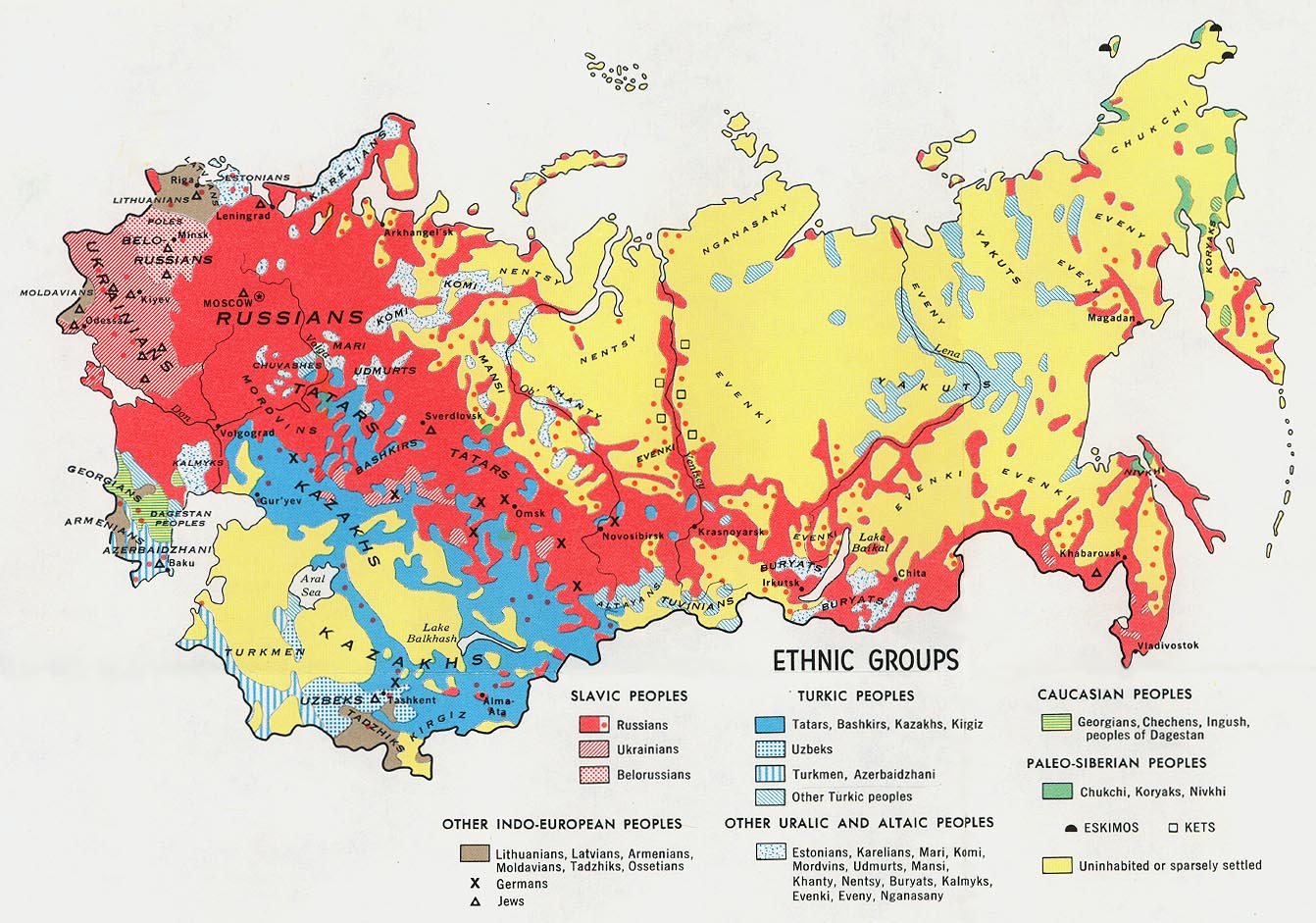
Nationalities in Russia: an Excellent Example of a European  Problem.

Народность в России: необыкной Премьерn всеевропейского вопрос


Les nationalités en Russie: un exemple excellent d'un problème européen. 

Nationalitaeten in Russland ein ausgezeichnetes Beispiel einer europaeischen Probleme.

1.     Nationalities in the Empire

Hostile propaganda, starting from XIX Century, described Russia (not differently, from this point of view from Austria and Turkey) as a “Prison for the Peoples”. This negative stereotype was never been abandoned, either during the Sovietic Period, nor even today, albeit both the Bolsheviks and Elcin’s Russia had made, in fact, remarkable efforts for solving the “National Question”, in a way which cannot be described as prejudicially inconvenient for minority peoples, both the ones of Eastern Europe and of Northern Asia. On the contrary, one could even object that the choice of both the USSR and of the Elcin period was the one to foster and emphasize the role of “Republics”, from one side consolidating “Nationalities” which were, originally, just at their beginning, and, from another, privileging the “secession right” to the geopolitic interest for unity. Many people, not just in Russia, but all over the world, have found that this overwhelming role given to smaller nationalities has fostered disputes, and even wars, like the ones in Caucasus. 

Present-days Russia’s Constitution has included multiculturalism into its foundations. Russia's constitution is one of the few constitutions in the world expressly mentioning multiculturalism. Multiculturality has been a standing characteristic of Russia since the first phase of its history, the “Kievskaya Rus’”. Already at the times of the largest extension of the latter, the States of the Velikij Knjaz included Variags, Slavs, Finns, Turks (Qipqaq, Khazars, Cumans, Pechenegs).Even the "Slovo o Polku Igorevo", Russia's national epic, is filled with references to the Turkic Polovesian People.

Starting from the conquest of the Kazan Khanate in 1522, Russia had always had the problem to arrange the government of minority peoples annexed to the Empire, starting from the Tatars, which were the first ones to be subdued. Already the policy of the Tsar towards such minority nationalities was characterized by a large amount of ambiguity. Certain moments of decentralization, such as, for instance, the ones at the creation of the Tatar Khanate of the Kerimov, or of the autonomy of the Zaporozhie Cossaks and the Khanate of Crimea, and, finally, the policy of Catherine II at the occasion of the Legislative Commission, coupled with excesses of centralization, like the case of the Oprichnina, of the forcced conversion of Tatars, of the russification campaigns in Ukraine, Poland and Georgia.The recent disputes with Poland, Ukraine, Georgia, Chechnia, find all their far away roots in ancient events, such as the Rebellions of Razin, Mazepa and Pugachev, or the wars of Chamil.

Apart from Poland, which fought during the whole XIX Century for its independence, it is with the 1905 Revolution that the national movements of the different ethnic minority really started to enter into contact with the idea of the auto-determination of nationalities, as preached by the Austro-Marxists of Bruno Bauer, and which had been the basis of the decentralization of the Austrian-Hungarian Empire.
During World War I, the conquests of the German Armies, an, later on, of the White Armies and of the Allied Forces, permitted to nationalist governments to be set up in Finland, in the Baltic States, in Bielorussia, Ukraine, Caucasus, Urals and Central Asia.
In reality, the problematics of historical Russian “Nationality Policy” does not differ very much from the one of the others historical  empires (such as the Sacred Roman Empire, the Austrian Empire, the German Empire, the Ottoman Empire), which collided with the new idea of independent “national” States based essentially on a common popular language.

So, also there we experience the emergence of new, ethnic and religious nationalisms, such as the ones of Bohemia, of the Netherlands, of Italy, Hungary, Croatia, of Greece, of Serbia, of Romania, of Bulgaria, of Albania, of Arabia,of Tibet, of Xin Jiang and of Mongolia. Also here, we can see the progressive emergence of a “core nationality”, which does not include just the former “core folk”, but was the result of a beginning of “Melting pot”. From another point of view, the dialectics between the “core” melting pot and its peripheries is vivid in several European “Nation-States”, what show a degree of ethnical differentiation, not dissimilar from the one of some “empires” (as, for instance, in Spain, Great Britain, France, Italy, Bulgaria, Turkey, the Baltic States  and Georgia, where "minorities" amount to very high percentages of the poplulation, even surpassing 50%).

2.     The Sovietic Nationalities Policy

The Sovietic Nationalities Policy was influenced by Austro-Marxism and by Panturkism, and in its turn, influenced Yugoslav federalism (Alexandre Marc, Jovan Djordjevich), and even the “autonomies movents” in Western Europe (such as, e.g., the “Carta di Chivasso” and the concept of the “Autonomous Regions” and “autonomous Provinces” in the Italian Constitution, and, hence, the one of "Comunidades Autònomas" in the Spanish one. The Baku Congress, of 1st September 1920, marked a turning point in the Sovietic politics of nationalities, because it persuaded the Bolsheviks that national minorities were an essential and necessary part of the Leninist Project of “Socialism in a Sole Country”. Moreover, thanks to the “Nationalities Policy”, Soviet Russia hoped to reverse, in its own favor, the traditional risk of destabilization of minorities by foreign powers. In fact, Russia presented itself, at the Baku Congress, as the defender of the oppressed nationalities worldwide, and, especially, in Asia.

During that period, Russia entertained a friendly relationship with the Chinese nationalist party GuoMingDang, forcing the Chinese Communist Party to merge, for a certain period, with that party, and, in any case, to maintain a sort of alliance with it up to the end of World War II.

The nationalities policy, whose supreme expert in the Communist Party was Josef Stalin himself, maintained the same degree of ambiguity which had reigned during the Tsarist period.From one side, the Soviets, for persuading break-off Republics, like Ukraine, Belarus and Caucasus, to join the new Sovietic Union,  went on fostering a policy of autonomy of such Republics, encouraging, i.a., the establishment of specific national ruling classes, of national government bodies and of a national language (which often did not exist  beforeas such and was created expressly); from another side, they went on utilizing Russian (or Russian speaking) political personnel, including, into each republic, important foreign minorities (including ethnic national minorities) and fostering large scale migrations among the different republics.

So, in practice, the life of the Republics remained always “split” between local, fledging, national identities, and a strong presence of the Soviet Communist Party, of the Soviet Centralized State, of many and many minority citizens and “Soviet citizens”, which in “intra-community lives” spoke Russian.
So, a certain degree of conflictuality between Republic and the center never ceased to exist, and it was only the totalitarian rule from the center which guaranteed that Republics could hold together, developing along a consistent political and economic path

Thursday, July 21, 2011

"Duszą Narodu polskiego jest pielgrzymstwo polskie" (THE SPIRIT OF THE POLISH PEOPLE IS POLISH PILGRIMAGE)

The Kingdom of Poland, a failed tentative of union between Russia and Poland.
Польское Королевство: не успешная попытка соединения полши и России
Il Regno di Polonia:un tentativo non riuscito di unione fra Russia e Polonia
 Le Royaume de Pologne: une tentative non réussie d'union entre Russie et Pologne
 Koenigreich Polen:  erfolgloser Versuch  von Union zwischen Russland und Polen.


Another question which was, and still is, common to Poland and Russia is the “Polish Question”, which rendered, at that time, and still renders, bitter and bitter the relationships between Russia and the rest of Europe. At the beginning, the first partition of Poland had not caused any important cultural reactions, either in Poland itself, nor abroad. In fact, in the middle of XVIII Century, there was nowhere a strong national feeling, and, in particular, Poland had never been a strong centralized kingdom. On the contrary, it had evolved, during the last two centuries, into a loose confederation of a myriad of feudal lords, which was governed by an elective King (usually a Swede, a Hungarian or a German), and, in the last period, was under the alternate influence of Prussia, Russia and Austria. The Three Partitions involved all the three monarchs.
In the meantime, during the XVIII Century, from one side, both the idea of nationhood, and the one of liberalism,  had started becoming more sensitive, also in Poland, and, from another point of view, it resulted clearer that, with the partition, the foreign influences, which had been important also before, were reaching a level which was no more tolerable, at least for little aristocracy (“Szlachta”), which was not connected with the foreign kingdoms like higher aristocrats.
This had led to a subdivision of the aristocracy (which remained the leading social force in Poland), into two “fields”: from one side, the “Whites”, around the great aristocrats, like Poniatowski and Czartoryski, which accepted a certain extent of influence of Russia, and, from the other side, the “Reds”(like Kosciuszko and Mickiewicz) which included mostly the small aristocracy and the bourgeois, which were contrary to any accommodation with the occupation powers, and opposed themselves militarily.It is worthwile noting that the distinction between “Reds” and “Whites” survived the Polish Independence Wars, and transferred itself to the Russian Civil War.
The accession of the Polish politician Czartoryski, after violent struggles, to the role of Foreign Minister of Russia had arisen the hope that a new, “liberal” policy of Alexander 1st would have found, via Czartoryski, a solution satisfying all the Poles.
Czartoryski, consistent with the general vision, shared with Alexander 1st, of Europe after the Vienna Congress, where a place would have been left to the “Europe of the Peoples”, worked out the idea of a constitution of the Polish Kingdom within the Russian Empire, alongside the “Konstytucja Trzeciego Maja” and the Finnish “Constitution”, as well as the one of the Duchy of Poland established by Napoleon between 1807 and 1813. .
The furtherance of the “constitutional experiment” in Poland and Finland, if successful, could have become an anticipation of an alternative “reformist”, path to the creation of a “Europe of the Peoples”, by gradually granting autonomy to the territories of the Russia, German, Austrian and Ottoman Empires (and, why not, of other large European States), without the need of two centuries of uninterrupted wars and revolutions.
However, the solution was not accepted by the Poles; Poland insurged, and Czartoryski himself, after having become the Prime Minister of the insurged Poland, was condemned to death, fled from Poland andcontinued to keep alive from Paris the conservative Polish opposition, whilst Lelewel headed the progressive opposition from Brussels.

Wednesday, July 20, 2011

A "EUROPEAN CONFEDERATION”: A LEGACY OF ALEXANDER Ist


The Emperor of the Europeans 
Царь  европейцев
L'imperatore degli Europei
L'empereur des Européens
Der Kaiser der Europaeer


Notwithstanding the change of Catherine’s mood towards Reforms after American and French Revolution, the relationships of the Russian Empire towards France and Napoleon was never completely negative.
The Czar Alexander 1st was a follower of Freemasonry. During the first part of his reign, he was considered as favorable to reforms, and, by the Tilsit Treaty, he tried even to reach an agreement with Napoleon. However, the decision, by the latter, to invade Russia, left to him no other choice  than war. He was surrounded, from one side, by Freemason intellectuals of the most different orientations, and, from the other, by middle-of-the-way liberal reformers, such as Czartorysky and Novosiltsev, with whom he entertained complex relationships. In particular, Czartorysky, who had been active in the last struggles in Poland before the Third Partition, but who was a personal friend of the Tsar, had worked out, with the consent of the Emperor, a project, which merged the experiences of some pre-revolutionary constitutions, like the Polish “Konstytucja Trzeciego Maja” (which had the approval of Rousseau) and the final act of the Finnish Estactes of Borgå, with the project of Catherine II for a new Russian Legislation, so envisaging to introduce into Poland and into Finland some limited reforms, as an example to be followed lateron  in other parties of the Empire (it would have been the first occasion for utilizing the term “Finlandisation”).
One has to recall that the Finnish-Swedish aristocracy had even fought a war against the Napoleonic Swedish for maintaining its “Constitution”. On the contrary, the Polish Constitution of 1815, which referred to the Old Constitution of 1791, was not accepted by mainstream Poland, since it reflected just the ideas of the higher aristocrats.
For Russia, the Napoleonic invasion in 1812 resulted in a unique experience, which deeply influenced its perception of the world. It had, on the self-consciousness of Russians, an impact similar to the one had in other countries of Europe (such as, e.g., Spain, Italy and Germany), i.e., the raising of the national feelings. However, this feelings were different in scope. In first instance, the special scope of Russia emerged from the fact itself that it was Russia, and Russia alone, which, with its resistance to Napoleon’s invasion, determined the fall of the latter. It was precisely the disbanding catastrophe followed to the invasion of Russia the reason why the French Army was no more in a position to overcome its European foes.
It is true, the invasion of Russia from the West had never succeeded, as experiences by the Poled and by the Swedes. However, after the invasion of Napoleon, this invincibility of Russia was put under the eyes of everybody in Europe. This was sufficient to give Russia a special standing. But this was not enough. In fact, Russian troops had proven to be very effective all over Europe. An example for all: already in 1796, Suvorov had been able to defeat Napoleon in Piedmont, to conquer Torino and to recall the King of Sardinia (who, however, declined his invitation). Especially, Suvorov, himself a typical “national-popular” military leader, outbalanced Napoleon also in his policy of aggregating, under “Austro-Russian” flags, the Italian national voluntaries, as well as counter-revolutionary guerrilla. In this sense, even if this role has never been recognized, he contributed, at least as much as Napoleon, to anticipate the birth of Italian nationalism, in the same way as this happened with the other ant-Napoleon military movements in Germany, Austria and Spain. Moreover, Suvorov conducted an extraordinary campaign in Switzerland, for which he was designed as “The Generalissimo”.
At the end of the war, Russia’s armies were present even in France, and Russia was in a position to influence heavily the overall results of the Congress of Vienna.
Thirdly, the Russian Empire was a multinational entity, which could avail itself of the far-reaching experience of people like Czartorysky, who had been an active part in the political life of another big country, like Poland, where the newest reform trends were hardly debated and had found a first concrete step in the “Konstytucja Treciego Maja”.
Finally, the liberation war against Napoleon, which was called “The Patriotic War”, allowed also Russia to forge its own nationalism.
During the XVIII Century, the original identity of the Muscovite State, which had been imprinted by the religious heritage of the “Third Rome”, had been profoundly shaken. The rationalist attitude, as well as the foreign nationality, of some monarchs (like Catherine II), together with the huge influence of Polish, German, Swedish and Tatar aristocrats, as well as of Italian, French, English and Scandinavian artists, architects and officials (who all spoke, among them, in French), had distanced the Court and the aristocracy from common people. By the way, it has to be remembered that personal serfdom was not a traditional Slavonic, or Russian, institution; on the contrary, it was consolidated precisely during the Catherine period, with something which can recall the idea of slave labor in the Americas and in the other European colonies worldwide of the same period. And, in fact, the revolts of Razin and Pugačiov recall, under many points of view, the contemporary anti-colonial revolts, such as the one of Tupac Amaru in Southern America, as well as the peasant revolts in the Austrian Galicia. On the contrary, the fact that, during the Napoleon wars, the aristocratic officials class had fought, side to side, together with peasants, for the defense of fatherland, had diffused a completely new mood. Intellectuals were encouraged to look for the “national soul” of the Russian people, alongside the ideals of Romanticism. This event raised, at the same time, the social consciousness of many aristocrats, like Prince Volkonskij, or the Decabrists, and the utilization of national language instead of French.
The growing importance of the peoples rendered it impossible to impeach also all the infinite other ethnic entities of the Empire (starting from Poles and Finns, but going down to Caucasians and to Lithuanians, up to Ukrainians and to Jews) to vindicate their respective nationalities, languages and identities, as well as an increased role for lower classes. It is the moment when Kalevala were written by Lömroeth and Pan Tadeusz and Dziady by Mickiewicz, and, and when Hadzi Muhammad and Chamil raised the Daghestanian and Chechnyan revolts.