Showing posts with label Ukraine. Show all posts

Wednesday, July 27, 2011

RUSSIA IN THE EUROPEAN CIVIL WAR

 
From 1917 ,up to 1945, a Standing War
Oт 1917 до 1945, непрерывная война
Dal 1917 al 1945, una guerra ininterrotta.
A partir de 1917 et  jusqu'à 1945, une guerre sans cesse
Seit 1917 bis 1945, ein ununterbrochener Krieg

 1.The controversial role of Anticommunism

Another reason why Russia remains so strongly associated with communism is that, for a broadly shared (but, according to us, not so much sustainable) view, all main historical events which took place over the XX Century were originated by the very presence of communism. So,the fact  having Russia been the center of the communist movement for 70 years, would imply, according to many observers and citizens, a central role of communism for Russian identity still today.
Summarizing the above theory, the fear of Communism at the end of World War I would have been the origin of the trend toward the radical right, and in particular, of the birth of Fascisms, which, from one side, were fighting against communism openly, and, from the other side, imitated its paradigms with the aim to entice the “traditional” audience of the latter (workers and intellectuals). This interpretation of XX Century’s history has been defined, by Nolte, as “Europäischer Buergerkrieg” (“European Civil War”). In its broader reading, the “European Civil War” encompasses also World war I and World War II, as well as the civil wars and the revolutions occurred between the two wars and up to the Georgia war of 2010 (such as the Russian Civil War, the Fiume Republic, the March on Rome, the Spanish Civil War, the Anschluss, the Greek Civil War, the Berlin, Budapest, Poznan’, the Danzig Revolts, the Greek Coup, Solidarność, the “Velvet Revolutions”, the Post-Sovietic and Post-Yugoslav wars).
According to that theory, communism had been the real protagonist of all those events, so that nationalism and capitalistic democracy would have been mere co-starring antagonists.
We do not object to Nolte’s use of the idiom “Civil War”, which stands on the basis that Europe is indeed “one Fatherland”. We just observe that capitalistic democracy and nationalism were the driving factors of World War I, and communism arrived during the war as a consequence of it.
The strongest evidence that Nolte gives for this theory in the book having precisely this title is the complete parallelism among all aspects of Communism and Nazism(Chiliasm; Party Dictatorship; Führerprinzip; “general mobilization”; exaltation of the “people”; ritualism; persecution of opposants; lager/GuLag; expansionism; “satellites”). 

2.Priority of Fascism
According to our point of view, the precedence of communism as compared with Nazism is misleading, because Fascism was born in Italy with Mussolini, and followed the exact timing of the evolution of Lenin’s Bolshevism:
-      pre-war socialist maximalism (1905-1914);
-      democratic interventionism (1915-1917);
-      militant  revolutionarism of Trockij and D’Annunzio (1918-1922);
-      party coup-d’état (1917-1922);
-   first phase of “national consensum” (NEP, first Mussolini Government) (1922-1926);
-      later development of an own “dirigistic” policy (1927-1933);
-      militarization of the State (1934-1938);
-      intervention in World War II beside Germany (1939-1940);
-      change of alliance (1941-1943)

As a consequence, we do not believe that the deep cultural  motives which brought to fascism were very different from the ones of Bolshevism:
-      activism of the cultural vanguards;
-      hatred for bourgeois “Biedermeier”;
-      militarism and/or militantism;
-      wish, by intellectuals, workers and beuaureaucrats, to conquer new social positions;
-      quest for State interventionism;
-      new ways for rehabilitating  nationalism.
The first mass applications of science and technique, such as industrial organization of production, gas and electrical lighting, and railways transportation, the creation of the first “national” conglomerates, the first traces of democratization, such as enlarging voting rights, tolerating strikes, encouraging mobility, the diffusion, through elementary schools and military service, of a “national” ideology, where at the origins of centralized States, colonial adventures, economic competition and mass parties, a set of forces striving to quick change and self-affirmation.
World War I allowed these forces to acquire a stronger role at the expenses of the peasant civilization, of the Churches, of aristocracies.
Both Lenin and Mussolini understood this, and were therefore favorable to the war, which gave them the means to emerge as political leaders.
After the war, the capitalistic and democratic American army started its presence in European soil, whilst large and ancient conservative empires were substituted by smaller and weaker “bourgeois” republics, plagued by civil wars carried out by demobilized soldiers trained to years of fighting. Bourgeoisie had gained a place besides aristocracy, thanks to the huge war profits, and socialist parties were admitted in parliament for the first time.
Communism started just as a consequence of the above. Lenin arrived in Russia thanks to the German Army, and was allowed to operate because the weak socialist government of Kerenskij could not prevent the birth and the operation of party militias. The Red Army was made up of demobilized imperial soldiers and officers, and could win the Civil Was thanks to the disintegration of the Imperial Army itself. Also Fascism and Nazism were strengthened by industrialization, mass democracy, war and demobilization. Also they started their political careers as party militias.

2.General Mobilisation
According to Ernst Junger, the key concept for understanding World War I is “General Mobilization” (“Allgemeine Mobilmachung”), which is the quintessence of any kind of modernity. The latter, in its sake for unlimited progress of science and technique, cannot tolerate that the forces of mankind remain, as it happened to a large extent in pre-modernity and up to World War I, dispersed and not operational. It demands that everybody and everything is put at work at the best of its potential, at the service of the development of science and technique. As Manuel De Landa has observed, war is the most effective instrument for innovation. Thanks to World War I, we have now economic planning, female work. Thanks to World War II, we have present days space industry, radars, computers, Internet, television, international organisations.
After its creation, Communism and Fascism became driving forces of European Civil War, because they were powerful elements of “General Mobilization”. The idea itself of an organized force taking the lead of the progress of Mankind stays at the center of “General Mobilization”. The same concept is true for the organization of a militarized and industrialized powerful empire, as well as of a massive propaganda in favor of progress, work ethics and technique improvement. 
So,  Russian Bolshevism became a protagonist of the European Civil War.First of all, it prompted other revolutionary parties, both communist and non communist, to follow the revolutionary path, so rendering possible events like the Sovietic Republics in Budapest and Munich, but also the Fiume "Republic of Quarnaro", the March on Rome, the Putsch Kapp and the Hitler Government. 

3.The Communist Bloc
Then, it created a worldwide communist movement, in competition with other international movements. Such movement, starting from the works of Lenin, of Trotzkij and of Stalin, developed its own ideology (and/or, even, political theology), which, gradually, evolved away from “traditional” Marxist thinking, so that, already after World War II, most Marxist thinkers in the West considered themselves as supporter of a different ideology as the one of Eastern Block’s “DiaMat” (Dialektičeskij Materijalizm).
Later on, following to the Budapest Revolution and to the ’68 movement, also most of marxist and communist parties in the West started criticizing the Soviet Union. In the meantime, in China, Yugoslavia, Albania, Romania, Cuba, other Communist Regimes expressed their own orthodoxies, conflicting with the Soviet one.
Finally, the development of Communism in the other parts of the Soviet Block, and even, to a certain extent, in some Sovietic Republics, revealed themselves different from the “Soviet” Mainstream. For instance, in Eastern Germany there has always been an apparent multipartitism, whereby all the political parties of Western Germany were present also in the Eastern Parliament (including the extreme right National Democratic Party). In Poland, the leading party was not a “party”, but a “Front”, whereby two or three catholic political movements, like Znak and Pax, were allowed. Moreover, the Church enjoyed a privileged role. From another point of view, it has to be remarked that some of the Republics, especially the ones at the borders of the Union, were allowed to enjoy a larger independence from the center, also because this would have been helped for a better image of the country abroad. For instance, a certain amount of economic independence was granted to Estonia and to Georgia, which allowed these small republics to become a center of local private trade, and to raise a sort of local “bourgeoisies”.
Finally, after World War II, it gave rise to one, and, later, to more than one, “socialist blocks”, in competition with the “Western World”, but also among themselves.

4.World War II

Similarly to what happens as concerns the interpretation of Bolshevism, so also the one of the origins of World War II has given rise to an infinity of discussions. Surely, the Molotov-Ribbentrop Pact, a non-aggression agreement between Communist Russia and Nazi Germany, was one of the main causes, since the first effect of that pact was a “fourth partition” of Poland, between the Soviet Union and the Third Reich, alongside the first three ones during XVIII Centuries.
This Pact is still now criticized by all sides, as a demonstration of the aggressive character of Russia, Germany, or both, and of the need, for Poland, to go on protecting itself with the help of the United States.
Surely, there is something true in this. However, a recent study has shown that, even now, there is clearcut cultural divide (expressed, e.g., in terms of election results), between the Polish Regions staying west, and the ones staying east of the former border of Russia. So, at the end of the day, it is not something unthinkable to imagine that many people were in good faith at that time thinking of a new form of partition, which corresponded to a real difference between the two part of Poland.
By the way, in Poland, between World War I and World War II, there was not even a sole legislation. In fact, in certain regions, German, Austrian, pre-war Russian, and, even, French/Napoleonic Law were applicable.
At the end of the day, thanks to World War II, Russia was able to recover that status of world power, that it had lost with World War I. Even after losing the Republics, present-days Russia has still maintained some element of that role.
In any case, the Pact has surely prejudiced very seriously the possibilities of good relationships among peoples in that part of Europe. This even more because, at the moment of restoring an independent Poland, the victorious powers maintained the “Curzon Line”, i.e. the partition line decided between Molotov and Ribbentrop, so setting free just the Western part of Poland, and just compensating the latter by the right of occupation of three formerly German regions, whilst the inhabitants of the Eastern Regions were transferred to these Regions (“Kresy” or “Lity”), and were given to Belarus and Ukraine (hence, to USSR and populations of these countries).
The trauma’s of World War II are not forgotten at all. Russia itself, albeit reneging completely the Soviet Heritage, considers the “Great Patriotic War” as one of the founding elements of its statehood In fact, it is thanks to the victory of Soviet Russia that the Soviet Union was accepted to be a part of the leading powers of the world, and, in particular, of the members of the Security Council of the United Nations. It is thanks to that victory that it has been able to develop an outstanding military technology which allows it to stand at pair with the US.
Recently, the myth of the “Great Patriotic War” has been revived, and President Medvedev has reaffirmed it at several occasions, albeit specifying that the victory has not to be considered as a victory of Stalin, but, on the contrary, as a victory of the Russian people.. Also in this theory, there is a part of truth. Apart from the fact that Stalin, albeit a tough dictator and a non-Russian Communist, was a theorist of “National Communism”, and, even involuntarily, succeeded to a liberation war which seemed lost, when Nazi tanks were at the doors of Leningrad and Moscow. So, the victory can be considered more a victory of the Russian people than of Communism.

6.Restless Eastern Nationalities
By the way, the questions of the Eastern regions of Poland had never been settled also before, because Poland, before the Partitions, was a multinational State, called “Rzeczpospolita”, and, especially in the Eastern part of it, lived, mixed the one with the other, Ukrainians, Belarussians, Poles, Russians, minor Slavonic peoples, Cossacks, Lithuanians, Jews and Tatars. The conflicts among those populations had been strong since the Cossack and peasant revolts, up to the fighting among Poles and Ukrainians, among the two World Wars, the exchange of populations after World War II and the persecutions of Jews starting from the late Tsarist Empire, up to the last “pogroms” in Communist Poland.
This also taking into account that many of the Republics (like, e.g., the Balts, Ukraine and Moldova), on the contrary, fought the war on the side of Germans. This last fact constitutes a further source of substantially unending disputes between Russia and the Republics. These are the only states in Europe where politicians and military, which had fought side by side together with the armies of the Axis, such as Bandera in Ukraine, are now considered national heroes.
This, of World War II, is a source of big contradiction in historical “orthodoxies”, not just for Russia and its neighbors, but for all countries of the World. It is clear that, because of its scope and its toughness, World War II could not have left the world unchanged. In fact, the main features of today’s world (American Hegemony, Europe’s division, resurgence of China, force of Russia), still depend on the outcomes of that war. Thus, no one of those who share the power in the world now has an interest to challenge the results of that war. Otherwise, America should give up hegemony, China its status, Russia its arms, and even the European elites their role as purported champions of western style freedom (whilst many, if not most of them, were, at the beginning, involved either in pro-communist, or in pro-fascist movements).
And, since symbolic power is stronger that military force, no one of the winners may give up to its own myths: not the war for democracy (when, in reality, the American war started with Pearl Harbour), not the cult of President Mao, not the one of the Great Patriotic War, not to the one of Résistance, a.s.o.. However, the interest of the Great Powers of today are often conflicting among them; so, some gaps open from time to time in the so-called “shared memory”: Bandera may become a national hero of Ukraine, and Stalin is a hero when he is seeming winning the war, but, therefore, the title may be withdraw, a tyrant when it is considered governing Russia.
We hope, now, that,65 years after the taking of the Reichstag,  20 years after the Fall of the Berlin Wall, and after the useful tentative to invade militarily Southern Ossetia, the “European Civil War” is really to an end.

7.A Useless Slaughtering 
Since, as we have seen, such “European Civil War” was started, not by communism, but by nationalisms and democracies, the end of communism would not mean, by itself, the end of such war. And, in fact, after the Fall of the Berlin Wall, we have still had post-Yugoslav and post-Sovietic wars, which have not been fought by communists.
From another point of view, Americans pretend that they have won the “European Civil War” with her victory on Communism.This historical interpretation constitutes in itself a further source of new conflicts. In fact, considering only the clash among ideologies, it negates the role and existence of the European nations, including Russia and Europe as a whole, and pretends to assert an overall “moral” authority which, in reality, is challenged by many.
According to us, in reality, plays are still open today, precisely as they were open at the beginning of the “European Civil War”. This is a very risky situation, but it is also what renders it worthwhile working for the future of Europe.
Still one general consideration. It is not always true that “History may not be made with ‘Ifs’”. If, starting from 1815, Europeans, instead of going through the path of wars and revolutions, would have followed the one set by the “Russian” version of the Holy Alliance (the “Christian Nation”, as well as the “Europe of the Peoples”), they would probably have reached in a much easier way, through treaties and reforms, the same point where they have arrived now after so many conflicts.

NATIONAL COMMUNISM

The Republics of the Russian Federation


Today, very few things remain of USSR, outside the Republics structure
Сегодня, остайотся немного CCCP, кроме устройства республик
Oggi, poco resta dell'URSS, al di là della struttura delle Repubbliche
Aujourd'hui, peu reste de l'URSS, au delà de la structure des Républiques
Wenig bleibt heute von UdSR ,ausserhalb der Strukturen der Republiken, uebrig.

Although, de facto, the Leninist revolution and the Stalinist “Nationality Policy” strongly contributed to salvaging the Russian Empire, which survived the Austrian, the Ottoman, the German, the Italian, the Dutch, the British, the French and the Portuguese empires, they were not perceived by all Russians in this way. On the contrary, Russian nationalism was, at least initially, completely on the side of the Tsar and of the “White” Army, and was severely deceived both by the signature, by Lenin, of the Treaty of Brest-Litowsk and by the murder, by Bolsheviks, of the Royal Family. Of course, within the  framework of Bolshevik Russia, there were also nationalistic tendencies, like, for instance, National-Bolshevism, which interpreted Bolshevism as a national phenomenon.
In a first phase, the Brest-Litowsk Treaty, signed by Lenin, recognized the independence of many Republics, and this was considered a treasure by many Russians. Moreover, once the peace treaty signed within Germans and the Bolshevik power established in Russia, the Russian Government started supporting the Bolshevik Parties existing in the Republic, exerting pressures on the local governments, in order that the role of such parties was enhanced. The protection of the local parties led to military interventions, which strengthened the idea of a tight connection between “Communism” and “Russian Centralism”.
During this period, a very complex political, military and theoretical activitym  took places, aiming at defining an attitude, by the new Bolshevik power, towards the multinational character of the former Russian Empire.
From one side, it was difficult to tell the Republics, once become independent, that they should revert to be a part of Russia. From another side, Bolsheviks were, to a large extent, foreigners to Russia, such as the Georgian Stalin, the Jews Kaganovich and Berija, the Polish-Belorussian aristocrat Dzerzhinski, the Ukrainian Khruschev,the Georgian Ordzhonikidze,  the Kazakh Frunze, the Baltic Tarle. Also important foreign communist leaders, such as Gramsci, Tito, Togliatti, lived in Russia for a shorter or longer time. Moreover, the Soviet Union, whose official denomination made no reference to Russia, gave a huge role, in its Constitution, to the newly created Republics, so frustrating Russians, whose Republic did not even possess its own Communist Party. The Communist Party itself launched campaigns against “Great Russian Chauvinism” and in favor of “Ukrainization”.
Finally, there had long been a Russian prejudice, which has not ceased even today, whereby the Republics were under-developed countries, maintained by Russia, a highly develop country just for political reasons. This had been, i.a during Perestrojka, the position of Alexandr Solzhenitsin, who wrote an essay (“Kak nam obostruit’ Rossiju”) proposing the secession of Russia and the “Slavonic” Republics from the Soviet Union. By the way, this is an idea which was accepted by the latter republics, and is pursued still today, with uncertain outcomes, by the most extreme circles of Russian Nationalism..
At the end of the day, the relationships between the Russian “center” and the “national” minorities has always been partially conflicting, as in all large States, albeit if less conflicting as in others like, e.g, in the United States, where Native Americans and the preexisting French-speaking and Spanish-speaking populations were practically destroyed over 100 years of “American” occupation.
Even an “affirmative action” of the Soviet Union from the point of view if its “internal” nationalisms, including Russian Nationalism, became always more evident with the passing of time. The cultural motivations and rhetorics of the “Great Patriotic War” were largely mutuated from traditional Russian nationalism (the reference to heroes of the past, such as Alexandr’ Nevsky and Ivan the Terrible, the identification of “Russia” with the “Soviet Union”, various practical privileges for people originating from the “core” East Slavonic peoples). As concerns other Republics, such as the Central Asiatic ones, they were practically “invented” by Bolsheviks, whilst, precedently, the idea was the one of a large Turkestan.
After World War II, in certain “pro-German” Republics, such as the Baltic States, Ukraine and Chechnya, the Russian language and Russian immigrants or minorities were inserted in order to avoid possible separatisms. Finally, when the Soviet Union became the center of a huge block of “socialist” countries all over the world, the fact of constituting the center of a huge alliance gave to Russian (if not also to other “central” nationalities) a great sense of power and of security.
Communism had taken 6 years for going to power and disappeared in 6 years.
The Russians could have become, with the time, the “national” core of a multicultural “empire”, like today’s Han for China and Hindustanis for India. On the contrary, with the crisis of the international credibility of the Soviet Union, following to the defeat in Afghanistan, a separate sense of identities of the different nationalities, including, in first instance, a Russian “national” identity, immediately reappeared. With the dissolution of the Soviet Union, Russian nationalism rapidly emerged as a driving force, even subtracting to the Communist Party the role of leading oppositional trends.
We must remember that, in the Russian Parliament, there are, today, four Parties: the majority party (middle-of-the way) is Jedinaja Rossija; the left opposition parties being the Communist Party and Spravedlivaja Rossija; the right wing opposition party is the Liberal-Democratic (nationalist). Moreover, there are smaller movements which are not represented in Parliament, the most important being the radical nationalistic Association Against Illegal Immigration and National-Bolshevik Party. A practical opposition role is also exercized by pro-western leaders, such as Kasparov and Nemtsov, supported by foreign ONGs present in Russia (such as the Fund for an Open Society). However, road protests and underground popular culture are clearly on the side of Russian Nationalism, having, as its main targets, from one side, the West, and, from the other side, former Republics and their immigrants into Russia.
Thus, the problem of the relationship between the Russian nationality and the former USSR Republics is not overcome. On the contrary, it is a fundamental problem, as stressed by Russian authorities.But this has nothing more to do with communism.
A last question. People often ask themselves why, notwithstanding the horrors of the Civil War and of the Stalinist Repression and the “economic stagnation” of the Brezhnev period, as opposed to the present bonanza, many people in Russia are still nostalgic of Communism. A part the fact that it seems that the number of nostalgics of Tsarism is still higher, the answers could be numerous, but are often not pertinent. We would try to add here some words for a tentative explanation.
Summing up, one answer might be that, contrary to the usual rhetoric, there is no pre-determined reason according to which people who have experienced different socio-political systems must necessarily prefer Western style capitalistic democracy.
Specifically, the major achievement of Russian communism was to have been able to create, and to maintain alive for 70 years, a whole worldwide system able to compete, under all points of view, with the system created by worldwide capitalism. We are perfectly aware of the huge weakness of this system (contradictions with its premises; technological and military inferiority; rigidity) so that it could not help but to fall. And, yet, the existence of an alternative to the Western Capitalism was a conceptual need for all the world. Not because of a specific fault of Western Capitalism. But, just because the latter pretended, and still pretends, to be the only valid system for all the world. Now, whichever system, even the better, if imposed on all the world, would come out to be the harshest of tyrannies.
Today, many contend that it is impossible to create a system which constitutes a full-fledged alternative to Western Capitalism, because the latter would correspond to “the nature of man”, to the “natural selection principle”, an “intelligent design” of God, or, even, to a sort of “Destiny of Technique”. And this could even be the case. But nobody can take away, from human nature, the temptation of contradiction, the illusion of freedom, the taste of a struggle without any chance.
But, irrespective from the sort of Communism, Russia can still now constitute an element of hope, at least for Europeans, that some form of international coexistence different from the simple acceptance of American model is still possible.

CRIMEA: THE FIRST EAST-WEST CONFRONTATION

Crimean War
Deep-Rooted Reasons for Hostility
Глубоко засевшие причины враждебности
Profonde ragioni di ostilità
Des raisons d'hostilité profondement enracinées.
Tiefgreifende Feindlichkeitsgruende.

The cultural confrontation among Slavophiles and Westerners, can be utilized as a background scenario of Russia’s cultural and political life up to the Soviet Revolution. The reformist “Russian Thinking” around Černyševskij and Herzen, comes out of a Westerner background, whereby the reforms are seen as a partial imitation of Western Europe or of America. On the contrary, most of the literary, and/or musical, and/or pictorial productions (such as Dostojevsk’s, Tolstoj’s, Ciaikowsky’s, Serov’s, Nestorov’s, Rerih’s, Malevič’s, Strawinsky’s) are deeply rooted in the Slavonic tradition.
The strengthening of the hold of the Russian Empire on its Asiatic territories (Caucasus, but also Central Asia and the Artic Regions) had increased the interest of Russian intellectuals for the Asiatic Roots of Russia (the Scythians, the Tatars, the Finns, the Persians, the Turks), but also their sympathies for the subjected peoples, whose origins, histories, traditions, languages, were investigated at that time.
Russia was defined more and more as a “Eurasiatic” reality. “Asiatic” subjects enter into the repertory of artists, such as Shagané, Hadij Murat, the Fire Bird, Shahrazade, the Finnish folklore of the North.This attention is not much different from the praise of Mohicans by Fenimore Cooper, or the one of "strong men" of East and west by Kipling, and, fimnally, the participation of Ann Besant both to the induistic revival and to the independence struggle of India.
But also the idea of a community of destinies between Russia and Europe remained at that times strong, albeit Russia felt not be  well understood , and even to be rejected, by Europeans.
Many made an effort to become more European, for being better accepted, as in the case of the Occidentalist, or of social reformers like Caadajen. Others, like Ivanov-Razumnik (who converted to Catholicism as suggested by De Maistre), stressed that Europe needed Russia. He launched the idea of “Europe’s two lungs”, an idea which will achieve so large a resound after having been adopted by John Paul II himself.
The conflict between “Slavophiles” and “Occidentalists” will be synthesized, finally, after the October Revolution, by Blok, who, in his Panmongolizm, will submit, to Europeans, a dramatic alternative: either to accept, brotherly, the Russian as a part of the European family of people, or to find them hostiles, allied with “the Mongolic World” (now, we could think of China and of Islam).
During the XIX Century, Russia did not abandon the “Greek Project” (i Megàli Idèa”), albeit the independence of Greece was not achieved thanks to Russia (or, at least, not thanks to Russia alone); the newly independent Greece became open, besides Russian influences, also German and English connections.
The peak of anti-Russian feelings was reached between the 1848 Revolution and the Crimea War. Russia had intervened, upon request of the Austrian Emperor, in Hungary, for stopping the liberal and nationalistic unrests.Moreover, the Croatian Ban Jelacic, the Ruthenian  peasants and the Bohemian Pan-Slavists    had all supported the Emperor against the revolutionary, so causing all together the suppression of the revolts in the Austrian Empire. From this fact, Marx and Engels draw the pretext for a violent attack against the "peoples without history", responsible, first of all, to have supported the Russian and Austrian Emperors against the revolutionary movements. In 1853, there were not only the left-wing extremists, but also the bourgeois liberals governments of France and of England to be worried of the momentum gained by Imperial Russia by its presence in the Balkans  (including the occupation of Wallachia and Moldavia) and its support to Balkanic nationhoods.
The "Crimean War" consisted, in reality, in a vast encirclement of Russia by British, Franch, Austrians Turks and Sardinians, which took place along the Danube, in Ucraine, Crimea, Caucasus, the Baltic, the White Sea and the Pacific Ocean. The adhesion of the Kingdom of Sardinia was unequivocally motivated by the will of the liberal Cavour Government to join the liberal cohalition of Western constitutional monarchies, abandoning the traditional Russian friendship. The conservative opposition, led by Count Thaon de Ravel, refused to vote in favour of the war. The latter contributed heavily to the self-consciuosness of Russia, to the weakening of Austria, to the assertiveness of the Balkanic countries and to the strenthening of national feelings in Caucasian nationalities.
The Western alliance pretended from Russia the acceptance of some points, what Russia refused to do:
  1. Russia was to give up its protectorate over the Danubian Principalities;
  2. It was to abandon any claim granting it the right to interfere in Ottoman affairs on behalf of Orthodox Christians;
  3. The Straits Convention of 1841 was to be revised;
  4. All nations were to be granted access to the River Danube.
At the end of the war, these points were accepted by Russia only partially, and never fully complied with.
Wallachia and Moldavia, formerly under a strong Russian influence, united under the name of Romania, into a new state, where French and Italian influences are decisive, up to the point that the same Rumanian language is “purified” from many of the preceding Slavonic influences, so that the heritage of the Romans is put in the forefront.
Russia interests concentrated on the Slavonic peoples of the Balkans, such as Bulgarians and Serbians, which Russia helped in their efforts to become independent from the Turkish Empire. These efforts, which were at the origin of the “Balkanic Wars”, contributed to creating the background for World War I. 
Of course, not just Russia, but the whole system of powers of the Europe of that time, are equally responsible for the Balkan Wars and for the subsequent World War II. It has to be remarked that the Russian Tsars were active in the diplomatic scene, for fostering a movement for Peace and Disarmament (the Hague Congress for Peace was promoted by Tsar Nicolas II).
The policy of the Russian Empire in that period is rather contradictory. In fact, it had to manage too many contradictory tendencies. From one side, Russia was a very powerful, cultivated, and even rich, country, whose rates of growths were higher than the ones of Western Europe. From another point of view, riches was very unequally distributed, and this created strong social contrasts. The land reforms carried out at the end of the XIX Century, whilst fostering industrialization,also as a consequence of the Crimean War, had not solved the problem of a sound farming class.
The Tsar swinged between the tough defense of traditional autocracy and timid tentatives of reforms in the direction of a parliamentary monarchy, from avant-garde initiatives in the field of internationalism, such as the Hague  Congress, to military escalations, such as the ones in the Balkans.
The policy of Russia-bashing from the side of western goverments and intellectuasls went on. The fact that, contrary to what happened in France, Italy and Austria, liberal reforms had not been implemented during the largest part of the XIX Century were explained, as always, by the innate autocratic spirit of Russians. However, as always, many of the faults identified by polemists in Russia were, or false, a shared with many other European countries.
As an example, the myth, according to which the Russian Empire had to be considered as the main enemy of nationalities in Eastern Europe is not correct. It is true that a strong conflict arose since the beginning with Poles, who did not accept the partial autonomy role of the Kingdom of Poland. It is also true that the Empire forbade the Ukrainian language and the transliteration, into Latin characters, of Baltic languages. However, also Prussia and Austria had annexed large parts of Poland, where they had suppressed any form of autonomy, whilst Russia had been even helpful with Belorussian and Lithuanians, for asserting their own nationhood, after long centuries of dominance of the Polish language, aristocracy and clergy.Not to speak of the violent repression, by England, of Irish autonomy.

Tuesday, July 26, 2011

EAST EUROPEAN NATIONALITIES AND EUROPE

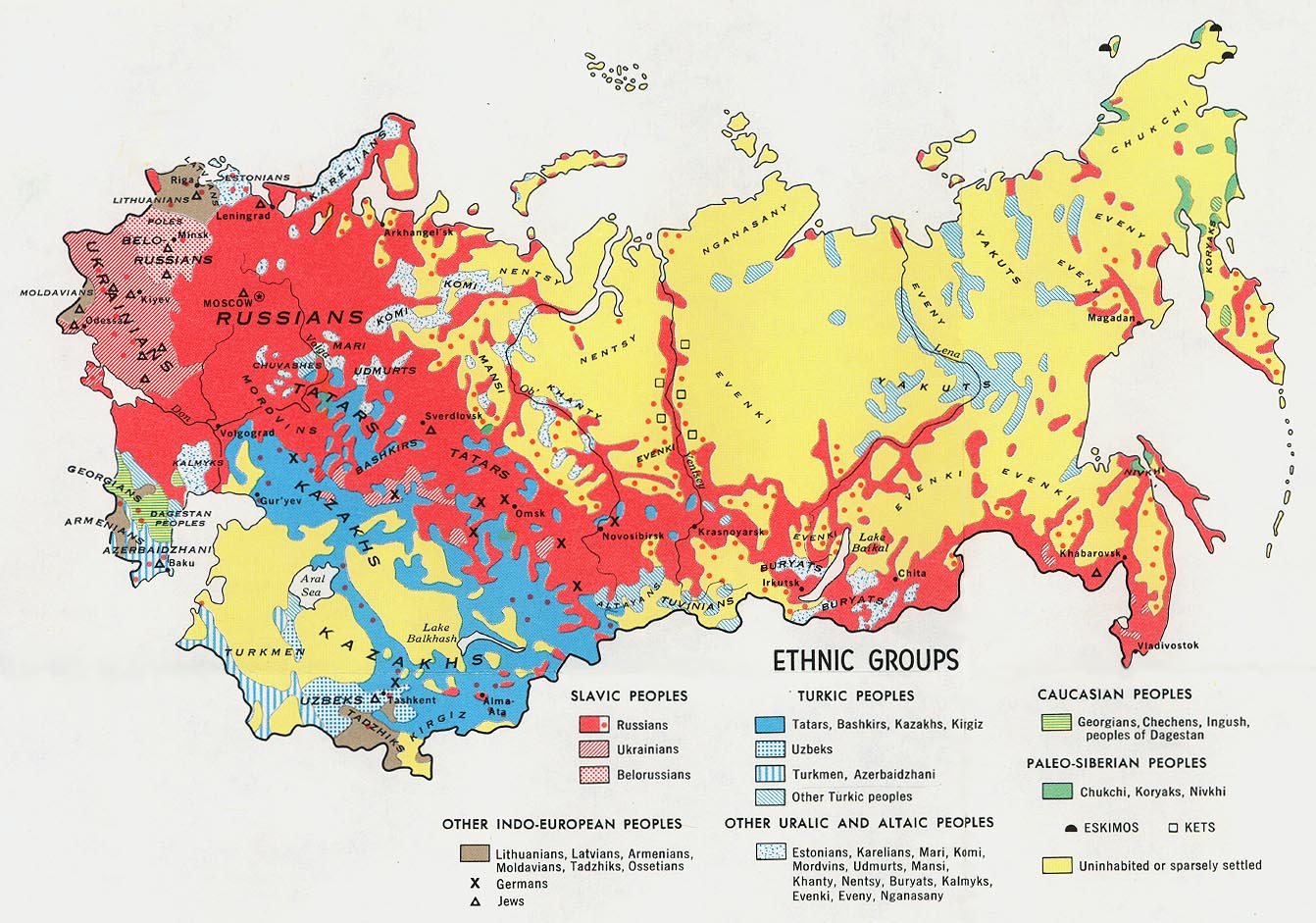
Nationalities in Russia: an Excellent Example of a European  Problem.

Народность в России: необыкной Премьерn всеевропейского вопрос


Les nationalités en Russie: un exemple excellent d'un problème européen. 

Nationalitaeten in Russland ein ausgezeichnetes Beispiel einer europaeischen Probleme.

1.     Nationalities in the Empire

Hostile propaganda, starting from XIX Century, described Russia (not differently, from this point of view from Austria and Turkey) as a “Prison for the Peoples”. This negative stereotype was never been abandoned, either during the Sovietic Period, nor even today, albeit both the Bolsheviks and Elcin’s Russia had made, in fact, remarkable efforts for solving the “National Question”, in a way which cannot be described as prejudicially inconvenient for minority peoples, both the ones of Eastern Europe and of Northern Asia. On the contrary, one could even object that the choice of both the USSR and of the Elcin period was the one to foster and emphasize the role of “Republics”, from one side consolidating “Nationalities” which were, originally, just at their beginning, and, from another, privileging the “secession right” to the geopolitic interest for unity. Many people, not just in Russia, but all over the world, have found that this overwhelming role given to smaller nationalities has fostered disputes, and even wars, like the ones in Caucasus. 

Present-days Russia’s Constitution has included multiculturalism into its foundations. Russia's constitution is one of the few constitutions in the world expressly mentioning multiculturalism. Multiculturality has been a standing characteristic of Russia since the first phase of its history, the “Kievskaya Rus’”. Already at the times of the largest extension of the latter, the States of the Velikij Knjaz included Variags, Slavs, Finns, Turks (Qipqaq, Khazars, Cumans, Pechenegs).Even the "Slovo o Polku Igorevo", Russia's national epic, is filled with references to the Turkic Polovesian People.

Starting from the conquest of the Kazan Khanate in 1522, Russia had always had the problem to arrange the government of minority peoples annexed to the Empire, starting from the Tatars, which were the first ones to be subdued. Already the policy of the Tsar towards such minority nationalities was characterized by a large amount of ambiguity. Certain moments of decentralization, such as, for instance, the ones at the creation of the Tatar Khanate of the Kerimov, or of the autonomy of the Zaporozhie Cossaks and the Khanate of Crimea, and, finally, the policy of Catherine II at the occasion of the Legislative Commission, coupled with excesses of centralization, like the case of the Oprichnina, of the forcced conversion of Tatars, of the russification campaigns in Ukraine, Poland and Georgia.The recent disputes with Poland, Ukraine, Georgia, Chechnia, find all their far away roots in ancient events, such as the Rebellions of Razin, Mazepa and Pugachev, or the wars of Chamil.

Apart from Poland, which fought during the whole XIX Century for its independence, it is with the 1905 Revolution that the national movements of the different ethnic minority really started to enter into contact with the idea of the auto-determination of nationalities, as preached by the Austro-Marxists of Bruno Bauer, and which had been the basis of the decentralization of the Austrian-Hungarian Empire.
During World War I, the conquests of the German Armies, an, later on, of the White Armies and of the Allied Forces, permitted to nationalist governments to be set up in Finland, in the Baltic States, in Bielorussia, Ukraine, Caucasus, Urals and Central Asia.
In reality, the problematics of historical Russian “Nationality Policy” does not differ very much from the one of the others historical  empires (such as the Sacred Roman Empire, the Austrian Empire, the German Empire, the Ottoman Empire), which collided with the new idea of independent “national” States based essentially on a common popular language.

So, also there we experience the emergence of new, ethnic and religious nationalisms, such as the ones of Bohemia, of the Netherlands, of Italy, Hungary, Croatia, of Greece, of Serbia, of Romania, of Bulgaria, of Albania, of Arabia,of Tibet, of Xin Jiang and of Mongolia. Also here, we can see the progressive emergence of a “core nationality”, which does not include just the former “core folk”, but was the result of a beginning of “Melting pot”. From another point of view, the dialectics between the “core” melting pot and its peripheries is vivid in several European “Nation-States”, what show a degree of ethnical differentiation, not dissimilar from the one of some “empires” (as, for instance, in Spain, Great Britain, France, Italy, Bulgaria, Turkey, the Baltic States  and Georgia, where "minorities" amount to very high percentages of the poplulation, even surpassing 50%).

2.     The Sovietic Nationalities Policy

The Sovietic Nationalities Policy was influenced by Austro-Marxism and by Panturkism, and in its turn, influenced Yugoslav federalism (Alexandre Marc, Jovan Djordjevich), and even the “autonomies movents” in Western Europe (such as, e.g., the “Carta di Chivasso” and the concept of the “Autonomous Regions” and “autonomous Provinces” in the Italian Constitution, and, hence, the one of "Comunidades Autònomas" in the Spanish one. The Baku Congress, of 1st September 1920, marked a turning point in the Sovietic politics of nationalities, because it persuaded the Bolsheviks that national minorities were an essential and necessary part of the Leninist Project of “Socialism in a Sole Country”. Moreover, thanks to the “Nationalities Policy”, Soviet Russia hoped to reverse, in its own favor, the traditional risk of destabilization of minorities by foreign powers. In fact, Russia presented itself, at the Baku Congress, as the defender of the oppressed nationalities worldwide, and, especially, in Asia.

During that period, Russia entertained a friendly relationship with the Chinese nationalist party GuoMingDang, forcing the Chinese Communist Party to merge, for a certain period, with that party, and, in any case, to maintain a sort of alliance with it up to the end of World War II.

The nationalities policy, whose supreme expert in the Communist Party was Josef Stalin himself, maintained the same degree of ambiguity which had reigned during the Tsarist period.From one side, the Soviets, for persuading break-off Republics, like Ukraine, Belarus and Caucasus, to join the new Sovietic Union,  went on fostering a policy of autonomy of such Republics, encouraging, i.a., the establishment of specific national ruling classes, of national government bodies and of a national language (which often did not exist  beforeas such and was created expressly); from another side, they went on utilizing Russian (or Russian speaking) political personnel, including, into each republic, important foreign minorities (including ethnic national minorities) and fostering large scale migrations among the different republics.

So, in practice, the life of the Republics remained always “split” between local, fledging, national identities, and a strong presence of the Soviet Communist Party, of the Soviet Centralized State, of many and many minority citizens and “Soviet citizens”, which in “intra-community lives” spoke Russian.
So, a certain degree of conflictuality between Republic and the center never ceased to exist, and it was only the totalitarian rule from the center which guaranteed that Republics could hold together, developing along a consistent political and economic path

Monday, July 18, 2011

BETWEEN RUSSIA AND EUROPE

Center-Eastern Europe at the Time of the Livonia War
Poland, Sweden,Belarus,Baltic States, Ukraine, Moldova, Turkey, had tight contacts among them in the Seventeenth and Eighteenth Centuries.
По́льша,Шведска,Беларус,Приба́лтика,Украи́на,Молдова,Турция  были тесно связанные в XVII и XVIII веке
Nel XVII e XVIII Secolo, Polonia, Svezia, Bielorussia, Paesi Baltici, Ucraina, Moldova e Turchia erano strettamente interconnesse
Aux Siècles XVII et XVIII, la Pologne,  la Suède,la Biélorussie, les Pays Baltes, l'Ucraine, la Moldavie et la Turquie étaient étroitement enchevetrées
In den XVIIen und XVIII Jahrhundert, waren Polen,Schweden,Belarus,Baltikum, Ukraine, Moldova und die Tuerkei, dicht miteinander gebunden. 
 
During and after the Mongolian domination, different parts of the Russian territory were subjected to the determinant influences of other, European and Asiatic, Kingdoms, and, in particular,Tataria,  Germany, Lithuania, Poland, Ukraine, Sweden and Turkey, so further increasing the cosmopolitan character of Russia.

1.     German Knights

Simultaneously with the Mongolian attack, also the German Knights of the Holy Cross tried to subdue the Novgorod Republic. However, Alexander Nevsky succeeded to defeat and to expel them by the battle of the Peipüs Lake.
The contacts with Germany continued nevertheless, thanks to the membership of Novgorod and other Northern Towns in the Hansa, thanks also to the family connection between the Russian princes and German aristocracy, thanks to the presence of a German heritage in the Baltic States, and, finally, thanks to the important immigration into Russia of German settlers, especially under the kingdom of Catherine II.

2.     Lithuania

During the Mongolian invasions, towns in the Western part of Kievskaja Rus, such as Novohradec, Brest, Mogilev, Minsk, were exposed to the influence of the Lithuanian princes. The latter, being still heathen, were exposed to several pressures to convert. As a consequence, there is, in Lithuanian history, a long-lasting trend toward Christian influences. The latter found their expression, in a first step, in the adoption of Greek Orthodox Faith and of Church Slavonic; later on, in the adoption of Catholicism and of Latin.
In the same time, the South-Western territory of the Kingdom of Halić fell under the influence of the King of Poland.
During the XV and XVI Centuries, the whole territory of present-days Belarus and Ukraine became part of a “Lithuanian Great-Duchy”, which, with its Orthodox Faith and its Slavonic language, could be considered as a sort of replica of the previous Kievan Rus’(and in fact, was still denominated also al “Zemlia Russka”).

3.     Poland

However, the personal union (Polish-Lithiuanian Rzeczpospolita) which, in the form of Unia Lubelska, transformed itself into a Polish hegemony, substracted force to Lithuania, and, hence, also to its previous Orthodox character. Ukraine became a part of the Polish Crown; Catholicism, Latin and Polish gained momentum.
During the period of the “Riots” (“Smutnoe Vreme”, Poles tried even to subdue Russia, arriving at conquering the Moscow Kremlin.
During that period, the Orthodox part of the former Great-Ducky of Lithuania, presently part of the Polish Crown, fell under the control of the Cossacks (the Hetmanate). In a first stage, the Cossack Hetmans governed this region (which stretched between Ukraine and Belarus) on behalf of the Polish King. However, at a certain moment, Hetman Chmel’nicky pretended to get a full autonomy from Poland, and, therefore, was attacked by the same. Chmel’nicky tried to resist Poland with the support of the Tatar Crimea Khanate and of the Ottoman Empire, but the Khan allied with Poles, so that Chmel’nicky was obliged to address himself to Russia.
As a consequence of the lack of success of the Polish tentative, the Muscovite Prince gained further influence also in Ukraine, and, during the XVII Century, with the Jaslav Convention and the Andrusovo Treaty, Kiev became a part of the Muscovite State. This situation gave rise to a growing Ukrainian influence in Muscovy, thanks also to the high level of theological development reached in Kiev’s Seminary.

4.     Sweden

Once the Polish influence finished, another threat was felt by the fledging Russian State: the power of the Kingdom of Sweden.
Following to the Reform and the Religious Wars, Sweden, during the Thirty Years War, had become able to reunite around it all Scandinavian States, more the Baltic States and the North of Germany, becoming a European great power.
Within this framework, the Swedes tried also to extend their power, from the Baltic territories, to Ukraine, across the previous lands of the Lithuanian State, thanks to the alliance with Hetman Mazepa, who tried to become independent from Poland, Russia and Turkey.
Also this tentative was unsuccessful. On the contrary, Paul the Great succeeded in defeating  the Swedes in Poltava and even to conquer all the stretch of Swedish territories on the Baltic, presently corresponding to the St. Petersburgkaja Oblast, to Estonia and Latvia. However, the Swedish influence on Russia did not cease with the Nordic Wars, but, on the contrary, went on also in the following centuries. In fact, in the Baltic States, besides the previous German aristocracy, originating from the German Knights of the Holy Cross, also a Swedish upper class had been created, which influenced the cultural life of the country and of Russia in general. For instance, the Admiral Vrangel’, one of the leaders of the White Russian Army during civil war, was of recent Swedish origins. Later on, in 1809, one of the reasons for the secession of Finland from Sweden, and the accession of the same to Russia, had been that Count Bernadotte, which, under French influence, had been appointed, by Napoleon,  as the King of Sweden, did not guarantee to maintain, to Finnish aristocracy (which was, in fact, nationally Swedish), the privileged guaranteed, under the previous dynasty, as the outcome of the “Constitution” of the “Borga Estates”.
So, Swedish-Finnish legal régime was “transferred” into Russia together with the Grand-Duchy of Finland, so constituting a basis for the reforms prompted later on, for the whole Empire, by Prince  Czartoryski.
This historical period had been also of paramount importance for the formation of the Finnish culture. At the moment of the passage of Finland from Sweden to Russia, and of the creation of the “Grand Duchy of Finland”, the need was felt to create a Finnish culture, instead of relying uniquely on the culture of Sweden, which had been, for the past, the almost sole culture of Finland. In fact, the ancient Ugro-Finnic population had been subjected to the Christian Swedes since the XIV Century, and did not have either a literary language, or a literary tradition.
At that moment in time, Lonnröth, going on the same path as Herder with Latvian ancient poetry, traveled intensively across Carelia, a Russian province inhabited by Finns, where he collected, from the voices of peasants, ancients legends, that he unified into the “Kalevala”, the national epos of the Finns. In so doing, he followed the same path of Macpherson, who, for his “Ossian”, collected Irish popular songs, unifying them into only one poem, and, then, pretending they were “Scottish”.
On the other side, the work of Lonnröth arouse an interest also on the other part of Botnia, in Estonia, where the Kalevi Poeg was composed, an epical cycle connected with the Kalevala.

5.     The Ottoman Empire

Whilst all these transformations were under way in the northern parts of Russia, in the South-Eastern part of it, and also in Ukraine, the influence of the Mongol and Tatar “Great Khans” had left place to the one of Turkey.
Both the Khanate of Crimea and the Nogai Horde had become vassals of the Ottoman Empire. This Turkish/Islamic influence is perceivable already now in those territories. In fact, all the Cis-Caucasian area was inhabited, together with Cossacks, by various smaller peoples, many of them, like the Daghestani and the Chechnyans, of Islamic faith. This area, formerly occupied by Tatars and by Mongols, Islam was often of recent date (like, for instance, in Ingushetia). For this reason, the cultural language was even Arabic, and the connections with Arabia were frequent.
These Islamic populations contributed heavily to revolts, including, i.a. to the one of Pugačiov, who, on the other side, had even an Arabic secretariate for drawing appeals and legislative instruments in that language.